Breaking The World’s Best-Kept Secret
Visibility reshapes power. What happens when it's better distributed?

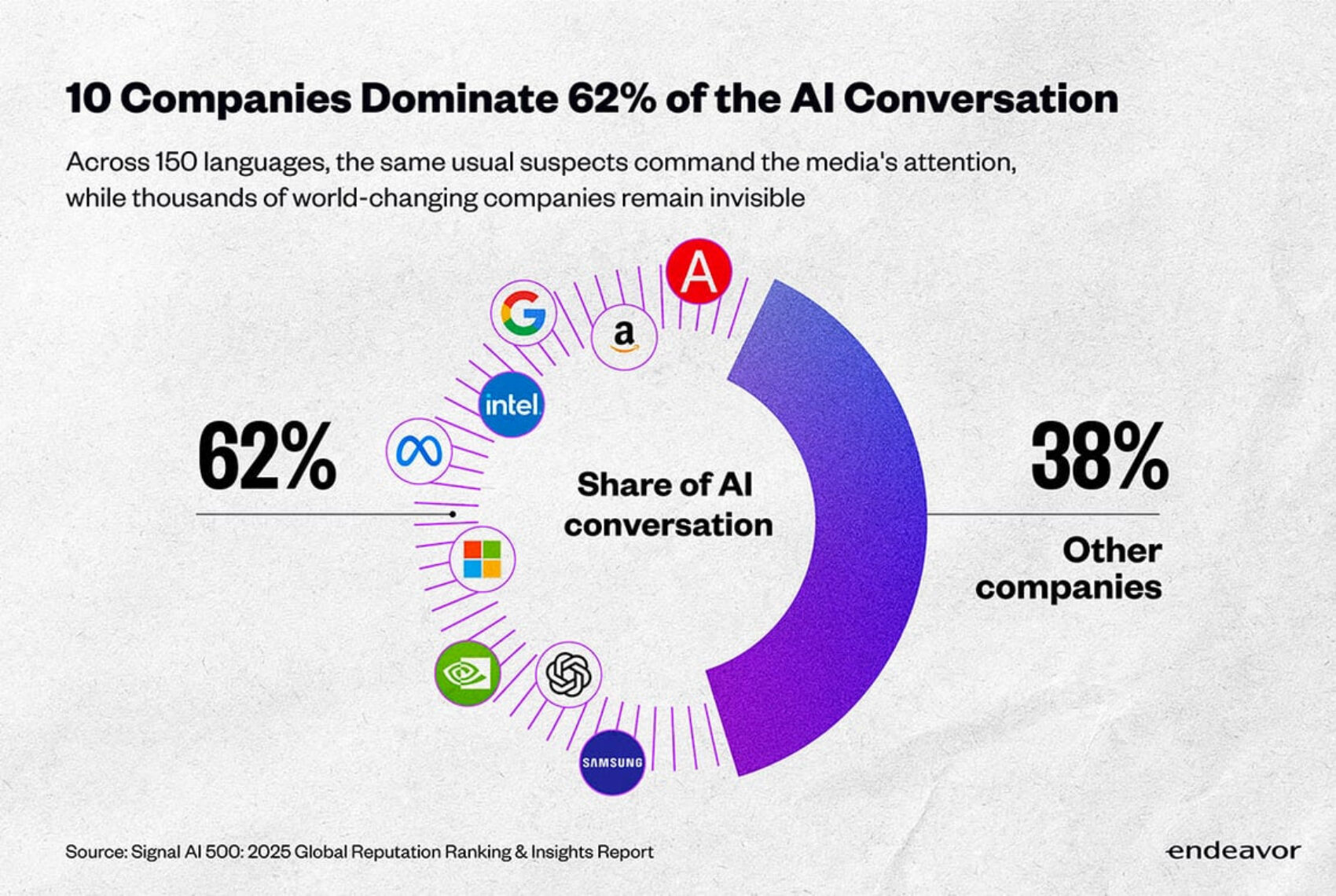
With all the talk of AI around the world, would it shock you to know that 62% of the media coverage across 150 languages was dominated by only 10 companies?
These are, of course, the usual suspects — Google, OpenAI, Nvidia, and so on. What about the rest of the brilliant AI companies everywhere else working to solve the world’s problems? For them, invisibility is, unfortunately, the norm. And for those founders, invisibility means:
- less capital
- fewer global partnerships
- lower talent attraction
- weaker regulatory influence
What is so astounding is that thriving businesses in Elsewhere — what we call markets outside Silicon Valley and China — end up being the world’s best-kept secrets. That may be good for investors and partners who were paying attention, but not so good for entrepreneurs who could use the visibility to accelerate growth for their companies and ecosystems.
As we traversed the globe over the years, we lamented the fact that the hundreds of stories we lived and saw everyday were not covered by traditional tech media: the Ukrainian founder who left London for Kyiv when the war broke out. The Italian PhD professor building the Internet of Underwater Things. The Chilean biotech controlling bacterial outbreaks. Problems get overreported, but not the solutions — nor the founders behind them.
Then we realized: why not take it upon ourselves to tell those stories? Here’s what changes when these stories come to light:
1. Role models open doors for next generation of founders to think globally
Representation changes behavior of the future generations.
When Alpaca became the first Japanese-founded unicorn scaling in the US, it reframed how much a company could expand beyond its home market. When Dr Nadine Hachach-Haram moved from the operating room to founding Proximie, a surgical intelligence healthtech from Lebanon, she expanded the definition of what a tech entrepreneur looks like. When Wences Casares — once a sheep farmer in Argentina — built Patagon in the late 1990s (and sold it to Santander), he kickstarted a chain of global tech founders in his country.
What if more people knew about them?
Seeing Bill Gates in Forbes is nice, but seeing someone who went to the same college or grew up in the same city as you expands the realm of possibility. Ambition is normalized, risk tolerance increases, and confidence rises: “If they can do it, so can I.”
2. New cross-border capital corridors emerge across Elsewhere markets
Global visibility can reshape capital flow from the US to Elsewhere in a fairly straightforward way: a market like Malaysia, Bulgaria, or Ecuador seems distant to an investor at first, until they start hearing about successful companies coming from there. These markets then get into the American investor’s radar who then, when presented with a new Malaysian, Bulgarian, or Ecuadorian company, may feel more confident in investing.
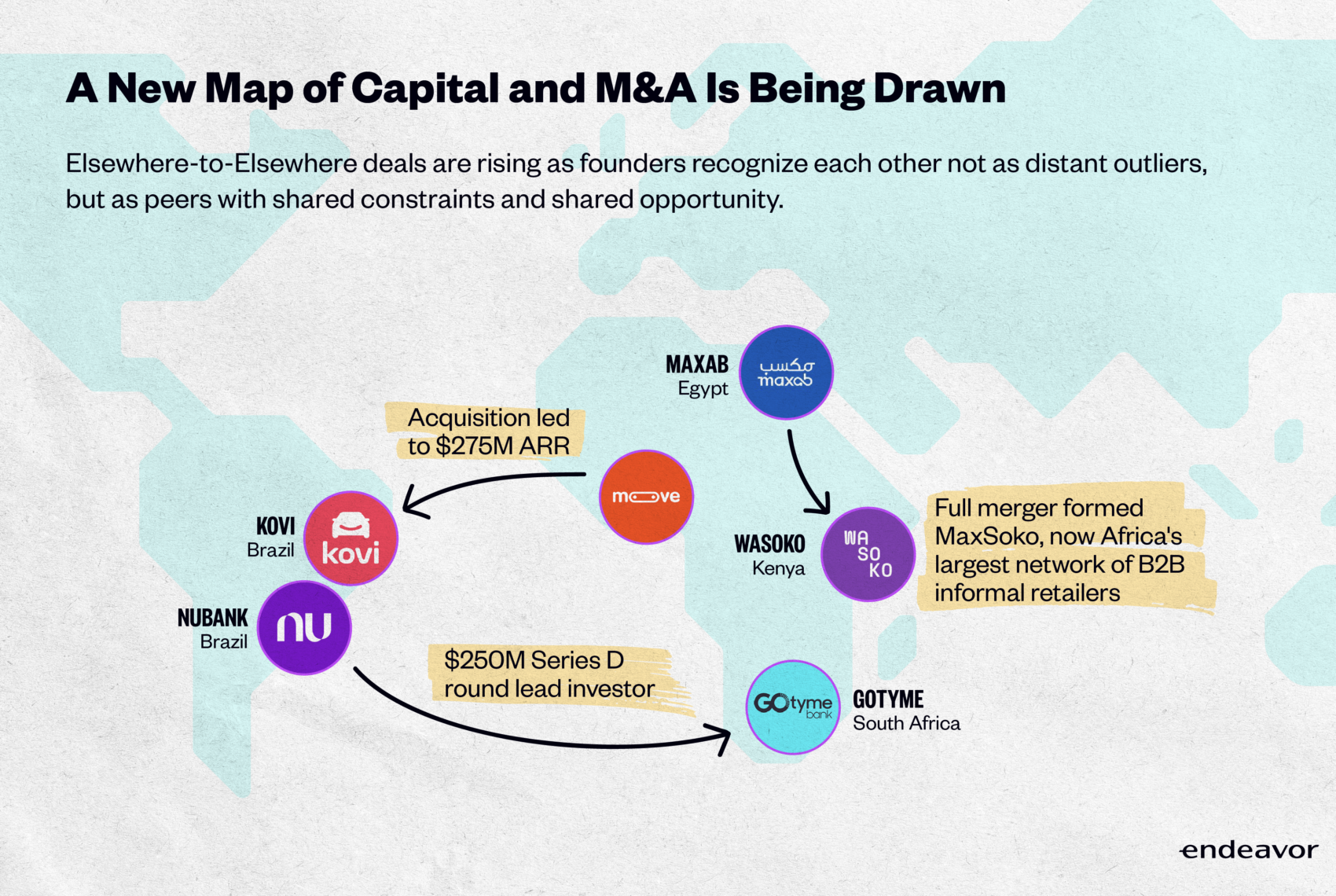
But a less obvious dynamic has been taking place, where founders from Elsewhere begin to see one another not as distant outliers, but as peers with shared constraints and shared opportunity.
The result is a rise in Elsewhere-to-Elsewhere investment and M&A. For example, in December 2024, Brazil’s Nubank led a $250M Series D in Tyme, a digital bank from South Africa that expanded into the Philippines. In January 2025, Moove — born in Lagos, scaled in London, headquartered in Dubai — acquired Kovi in Brazil, taking its annual revenue to $275M.
The most interesting growth corridors today are no longer only flowing from Silicon Valley outward. They are forming between emerging markets themselves — some of which may look very different on the surface, but share similar systemic gaps. When founders who have solved those constraints in one market invest in another, the learning curve compresses dramatically.
At Endeavor, we intentionally use Elsewhere as a unifying term to help founders more clearly recognize these commonalities and grow closer — not only as peers, but as benchmarks and potential partners who can strengthen one another across the globe.
3. Global frameworks start reflecting more of the world
“AI is going to affect every corner of the world, every industry, all parts of society,” said Sir Demis Hassabis, co-founder and CEO of Google DeepMind, at the Athens Innovation Summit in September 2025. “So I think it’s important for the world to have a say in how this technology is developed, not just a small part of California.”
We believe the same is true of entrepreneurship as a whole.
When only a few voices define the narrative around innovation and regulation, the outcomes reflect only a slice of humanity’s values and priorities.
Conversely, when founders and leaders from Elsewhere are included in global conversations, they bring local realities into the design, governance, and deployment of transformative technologies. They move from being case studies to becoming participants — and increasingly, architects — of global frameworks.
Though Elsewhere’s share of voice still has room to grow, examples are many:
- Karim Beguir, the Tunisian co-founder of InstaDeep — an AI company acquired by BioNTech — is not only a global thought leader, but also advises government bodies and has addressed the G7 on Africa’s AI future.
- The Polish decacorn ElevenLabs has just partnered with the UK government to study the societal and security implications of AI voice technology.
- Lateefa Alwaalan, who built and exited Yatooq in Saudi Arabia, became the first woman appointed to the board of the Riyadh Chamber of Commerce.
- Melvyn Lubega, founder of South African unicorn Go1, was appointed to lead his country’s new Digital Services Unit.
- Fabricio Bloisi, the Brazilian founder of Movile, the group behind iFood, was named CEO of Prosus and Naspers, leading one of the world’s largest internet investment groups.
Visibility influences who influences. Once a region is seen, it is invited into the room. And once it is in the room, it stops being labeled a growth market or a talent pool. It becomes a rule-maker.
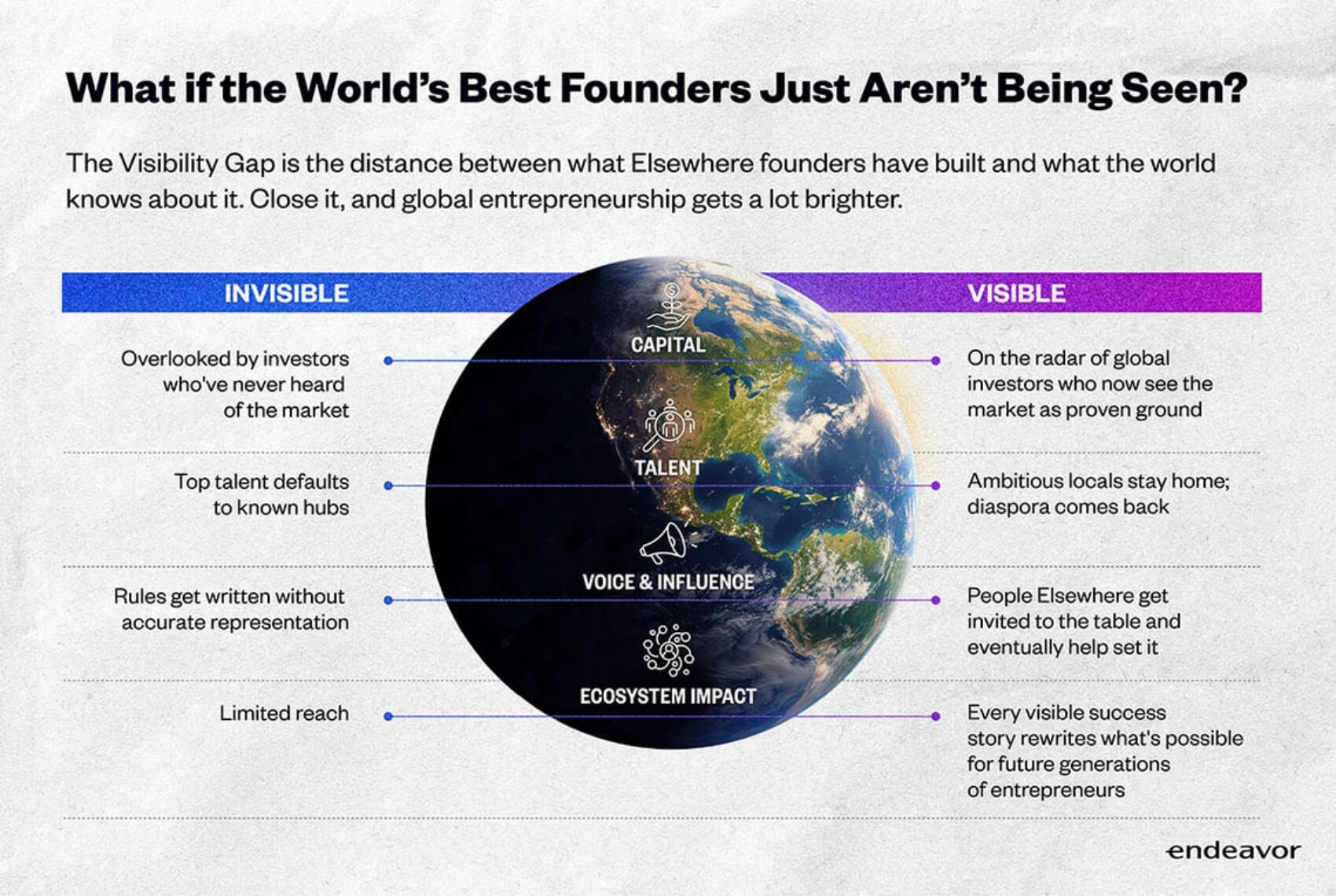
It’s only natural: we are trained to see headlines as a synonym for relevance. But every day, thousands of entrepreneurs are building something remarkable — in cities that might not be on your radar, solving problems you didn’t know existed, in a market the media ignores. We deeply believe reducing the world’s blind spots is a win-win.
As long as the visibility gap persists, we invite you to keep looking Elsewhere — and to let others in on what should never have been a secret. If it’s up to us, it won’t stay one for much longer.
" Talent lives everywhere and innovation thrives anywhere. Elsewhere is our way of proving it, story by story."
Silvia Cavalcanti
Endeavor’s Chief Marketing Officer
Featured Stories

Unicorns aren’t the end of an ecosystem’s success. They’re the beginning.


Beyond Skyscrapers: What’s Really Powering Entrepreneurial Innovation in Dubai
Related Articles