The Collapse That Forced Proptech’s Boldest Founders to Reinvent Everything
What happens when an entire sector hits a wall overnight? Here are some lessons from our proptech entrepreneurs who have made it out the other side.

“In times of crisis,” says Giorgio Tinacci, founder and CEO of Italian real-estate technology startup Casavo, “acting quickly is more important than overanalyzing.”
Giorgio learned to move fast when the ground was shifting under his feet. When he launched Casavo in Milan in 2017, the idea felt almost radical for Europe: an instant home-buying model that promised to renovate and resell properties faster than the traditional market allowed. In those first years, moving quickly was a competitive edge, a way to stay ahead of an industry still running on paper, brokers, and long delays.
But “fast” took on a new meaning in 2022. Interest rates shot up, transaction cycles dragged on for months, and the balance-sheet risk baked into so-called “iBuyers” like Casavo suddenly became the sector’s biggest liability. What had once been a disruptive reimagining of an old system turned into a race for survival across all of proptech.
Through it all, Giorgio — now an Endeavor Entrepreneur — kept returning to the same principle he shared in one of our proptech peer groups:
Staying anchored matters most when everything else is in motion.
“Our vision never changed,” he says. “That helped maintain alignment and motivation.”
Here’s what happened next in proptech, told by the Endeavor Entrepreneurs who made it out alive.
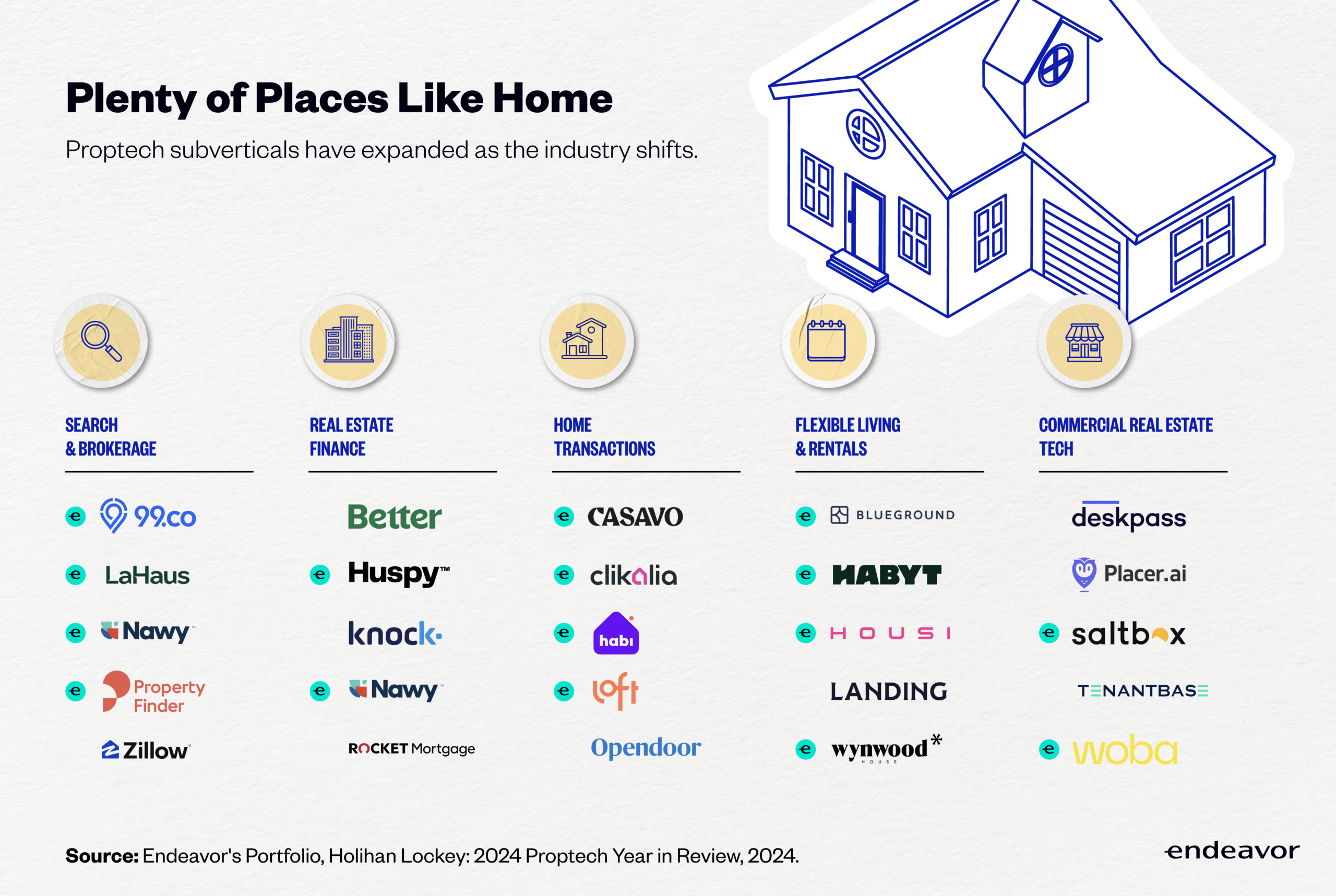
#1. Profitability Through Layered, Value-Added Services
Today’s proptech industry emerged from the ashes of the 2008 housing crisis.
The financial crisis exposed deep inefficiencies and a lack of transparency in the real estate industry, creating demand for the digital solutions that would come to define proptech. The following 14 years would be coined “The Decade of Cheap Money,” where venture capital, fueled by low interest rates from 2008-2022, saw record levels of deal flow and growth. Covid-19 also catalyzed investment in the proptech industry, with flexible space valued above all else. But in 2022, the music stopped, and many proptech companies crumbled under the burden of spiking interest rates. Suddenly, borrowing became expensive for everyone.
In this new environment, profitability through layered, value-added services has become the north star.
Casavo is a clear example. As financing costs rose, Casavo offered a new range of services, including brokerage, mortgages, and renovations, and created higher-margin lines that reduced exposure to pure inventory holding.
Other proptech models are seeing a similar shift. In Egypt, Nawy began as a digital brokerage simplifying property search in a fragmented market. As liquidity tightened post-pandemic and customer expectations shifted, the company broadened its offerings to include advisory, financing, and, most recently, fractional ownership, opening the door for individuals to invest in real estate with as little as $1,000 in a region where affordability remains a major barrier.
Habyt, founded by Italian Endeavor Entrepreneur Luca Bovone, reflects the same strategic logic. Alongside the global flexible hospitality brand, Habyt launched Atipico, an urban lifestyle hospitality concept tailored for a new segment of travelers seeking a home away from home.
Together, these companies reflect a broader shift across proptech: profitability is increasingly driven by layering services and building more comprehensive offerings, rather than relying on volume-driven transaction models alone.
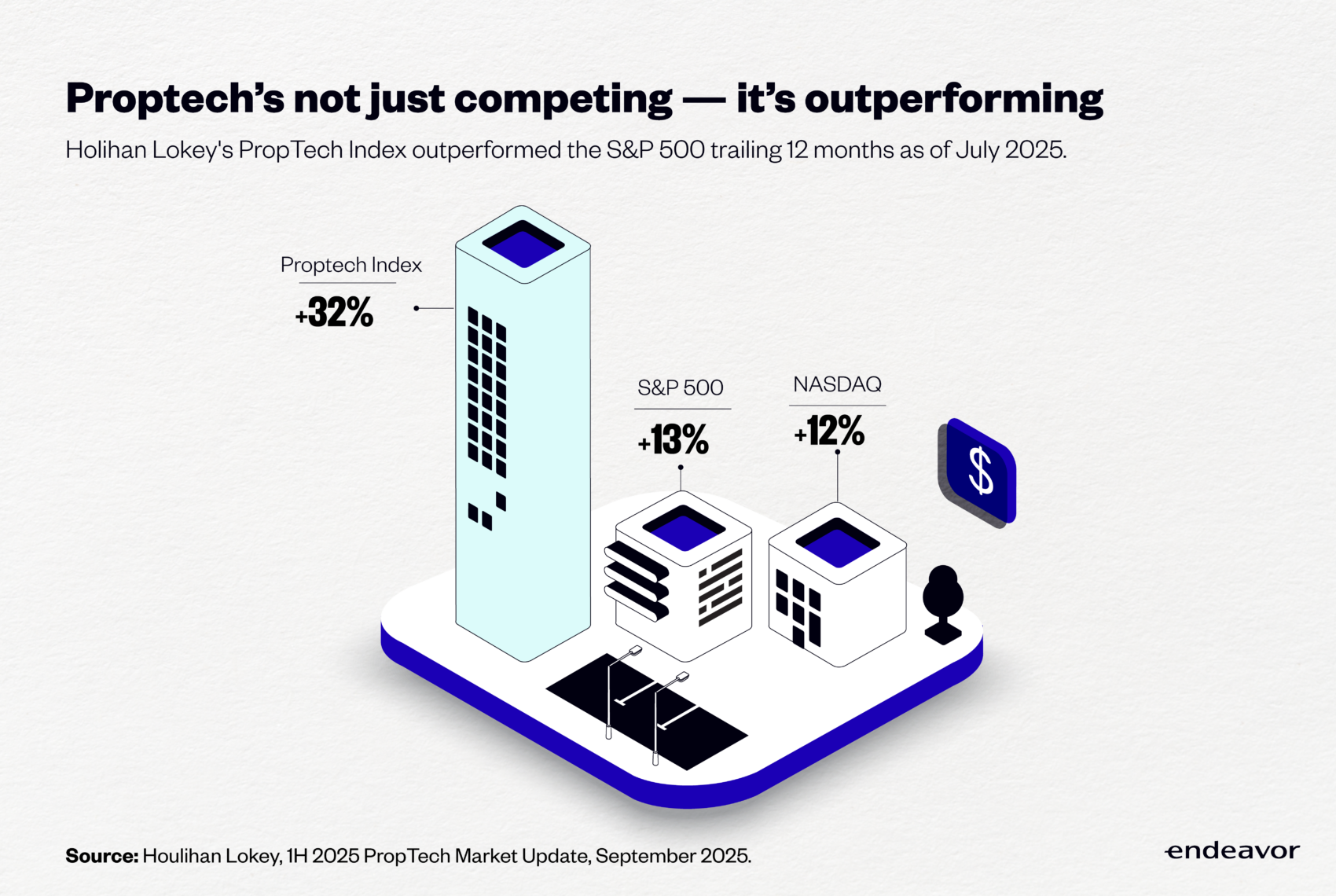
#2. Consolidation and Liquidity
As the industry matures, mergers and acquisitions have become a go-to strategy for growth. In Latin America, Wynwood House, founded in Peru, recently closed its first acquisition to accelerate growth in the short-term rental segment.
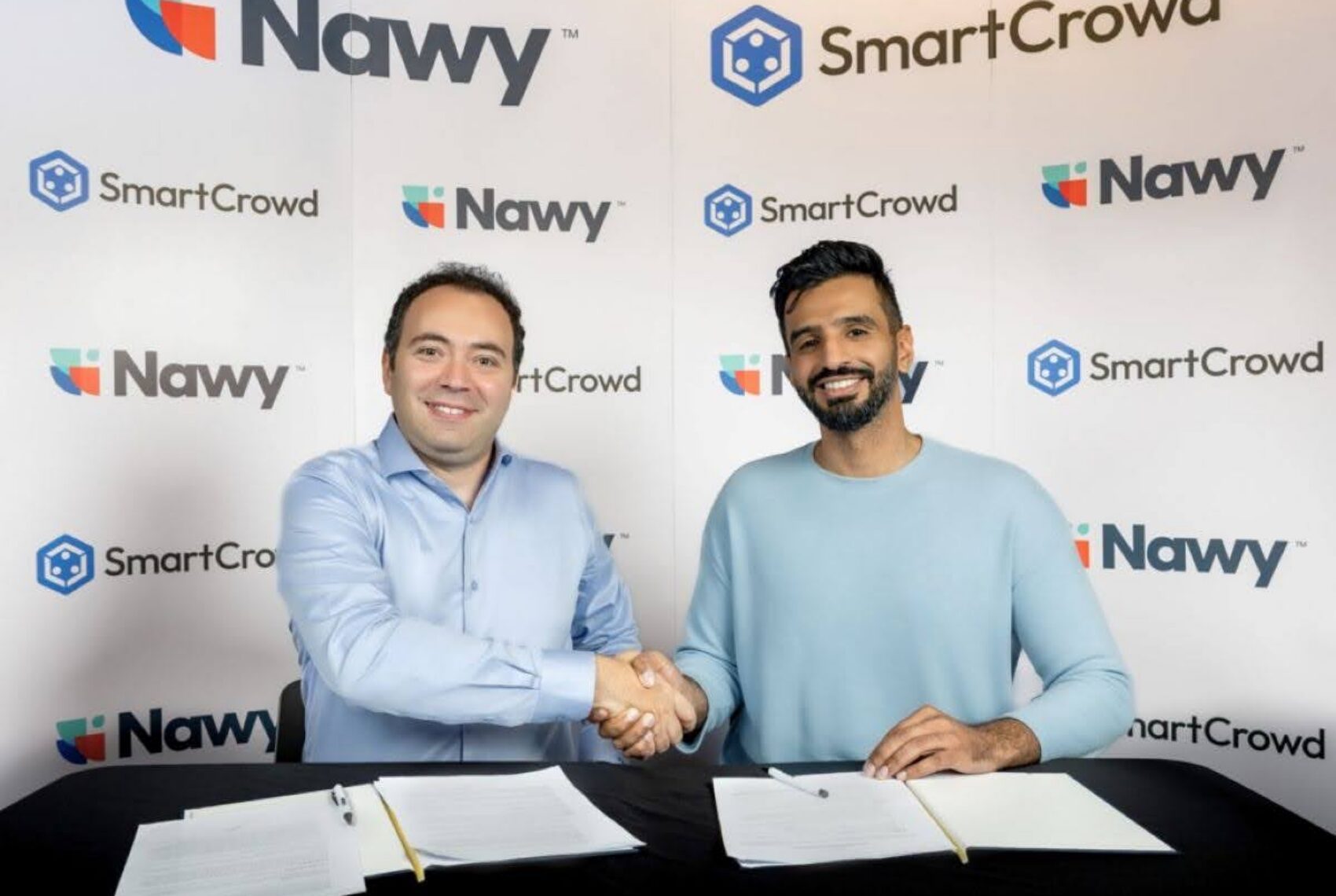
In Egypt, Nawy acquired a startup in Dubai to bring its fractional ownership structure to new markets. Even beyond Endeavor’s network, consolidation is redefining the sector: Rocket Mortgage’s acquisition of Redfin is just one high-profile example.
Liquidity is also showing up in different forms beyond traditional M&A. In the MENA region, digital marketplace Property Finder has demonstrated how mature proptech companies can create liquidity through secondary transactions.
As part of a company-led share buyback in early 2026, the business enabled a partial secondary sale, offering investors and early stakeholders a path to liquidity without changing the company’s strategic direction. The move reflects a broader evolution across proptech, where growth-stage leaders are beginning to use more sophisticated capital strategies as the sector stabilizes.
Entrepreneurs are quick to caution, however, that acquisitions can come with serious risks. While Habi, co-founded in Colombia by Endeavor Entrepreneurs Sebastián Noguera and Brynne McNulty Rojas, survived a VC winter and is now stronger than ever, its expansion into Mexico through an acquisition led to significant challenges, including talent attrition during the merger. Losing members of the team impacted morale and had a rippling effect across the organization.
Habyt, which has written its own M&A playbook with more than seven acquisitions and operations in 50+ cities today, has faced both successful and catastrophic deals, including an attempt to enter the US market that nearly bled the entire business to death. While M&A can accelerate market entry and provide opportunities for liquidity, cultural and operational alignment often determines whether a strategy succeeds.
#3. AI and Product Innovation
Alongside business model evolution, AI is emerging as a core driver of product innovation across the proptech landscape.
A growing set of use cases is taking shape: improving operational efficiency, enhancing tenant and customer experience, and automating workflows that have historically been manual and fragmented.
This shift is already visible across Endeavor companies. Colombian and Mexican marketplace La Haus is developing an AI-as-a-Service product for developers, while in Brazil, Woba leverages AI to automate supply-side onboarding, coordinate sales workflows, and enhance agent performance. At 99.co in Indonesia, AI-driven voice technology from ElevenLabs improves customer interactions, reducing friction and response times in markets where trust and transparency are essential.
Looking ahead, the role of AI will likely deepen across both proptech and construction technology, with applications spanning pricing optimization, predictive maintenance, and site monitoring, further embedding intelligence into every layer of the real estate lifecycle.
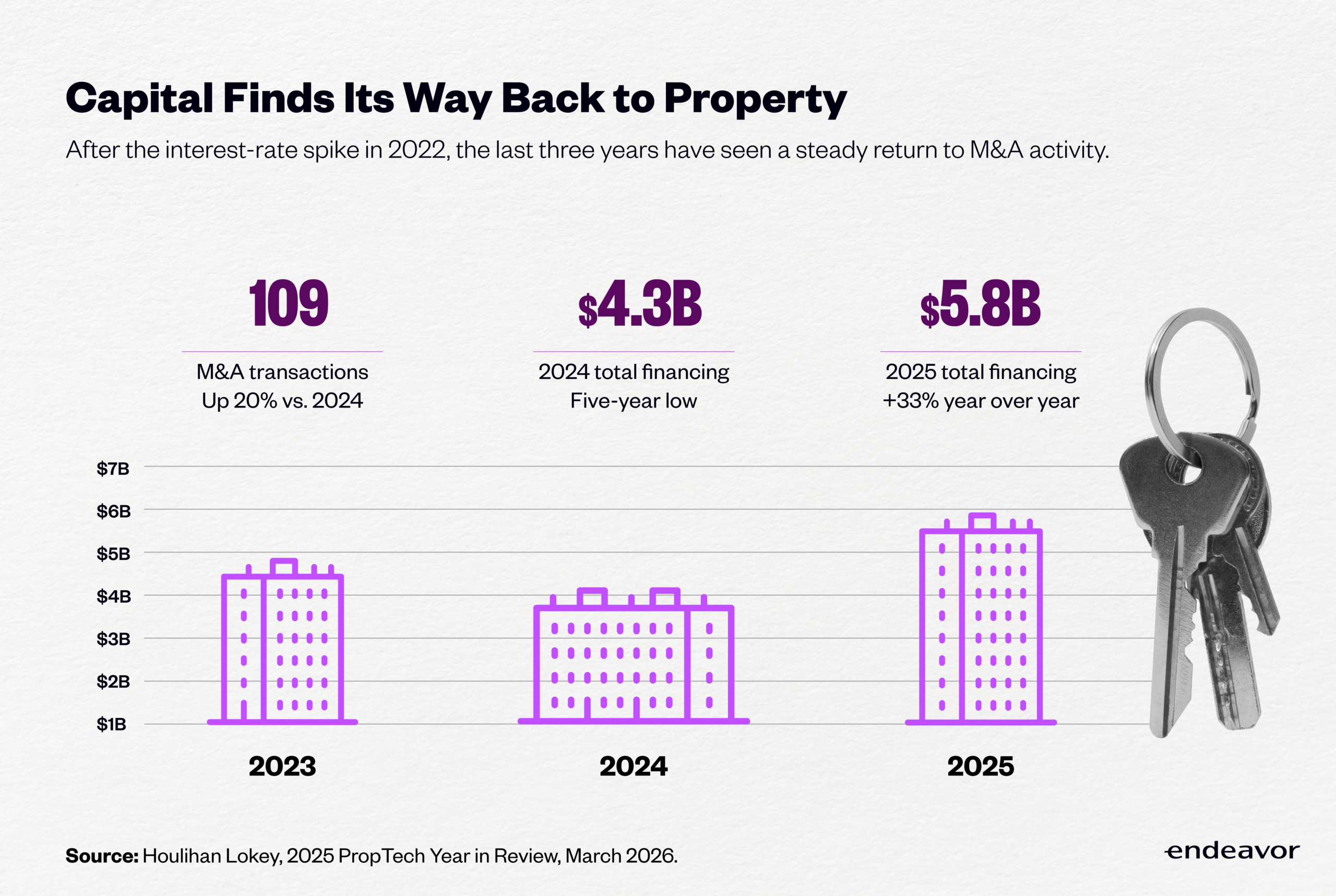
As the venture market gradually thaws, proptech is regaining momentum. Investors across Latin America are re-engaging: Woba in Brazil closed a $13.5M Series B led by BeWater with participation from Kaszek and Valor Capital, while Wynwood House in Peru and Nawy have recently closed their Series A and Series B rounds, respectively. And Casavo has just announced a roughly $14M (€12M) capital raise from new investors and existing shareholders.
Even as capital remains uneven, many Endeavor Entrepreneurs have continued to grow by rethinking financing and operations. In Southeast Asia, Bobobox, led by Antonius Bong and Indra Gunawan, pivoted from asset-heavy expansion to co-financing models with landlords. The company, which just closed a strategic funding round, works to unlock scale without carrying full ownership costs. These deals signal a renewed appetite for flexible and dynamic proptech solutions.
The companies that used the past few years to strengthen their economics and refine their models are emerging with a real advantage. As investment activity resumes, the proptech players that combine efficient operations, creative financing, and local execution are best positioned to reap the benefits when market conditions turn. Their trajectory underscores a broader truth that transcends industries: disciplined, vertically integrated, and locally attuned business models, especially those leveraging AI, are becoming the benchmark for success in 2026 and beyond.
Featured Stories


Unicorns aren’t the end of an ecosystem’s success. They’re the beginning.


Beyond Skyscrapers: What’s Really Powering Entrepreneurial Innovation in Dubai

Related Articles