Not all roads lead to Silicon Valley
How founders are scaling across borders without following the old playbook

If you’re from a smaller country, you may know what it feels like when your favorite musical artist announces a “world” tour.

For a while, when tech companies and investors talked about geography, it felt a little like that meme. They were talking “global” — but their maps were pretty limited to big well-known markets. Those deemed “worth the trouble.”
Those were different times. Most ecosystems were still undiscovered. There’s no excuse now.
Opportunity is abundant. And thankfully, the world is catching up: an expansion to Saudi Arabia is a lot less daunting; a move from Africa to South East Asia makes perfect sense; conquering Brazil is finally seen as the huge achievement that it is.
Instead of docking in the same harbors, companies are building entirely new trade routes. Although hubs remain alive and well, they’re no longer mandatory stops. Movement is less rigid. There are several new ways to be global.
Of this year’s 238 of our top performing companies — 2026 Endeavor Outliers — more than 80% operate beyond their home markets, and nearly half across regions. So we had a look at the patterns and how new pathways influence the way knowledge, capital, and talent moves Elsewhere — not just from the US and China. Here is what we’re seeing:
1. Regional Giants: Turning proximity into power
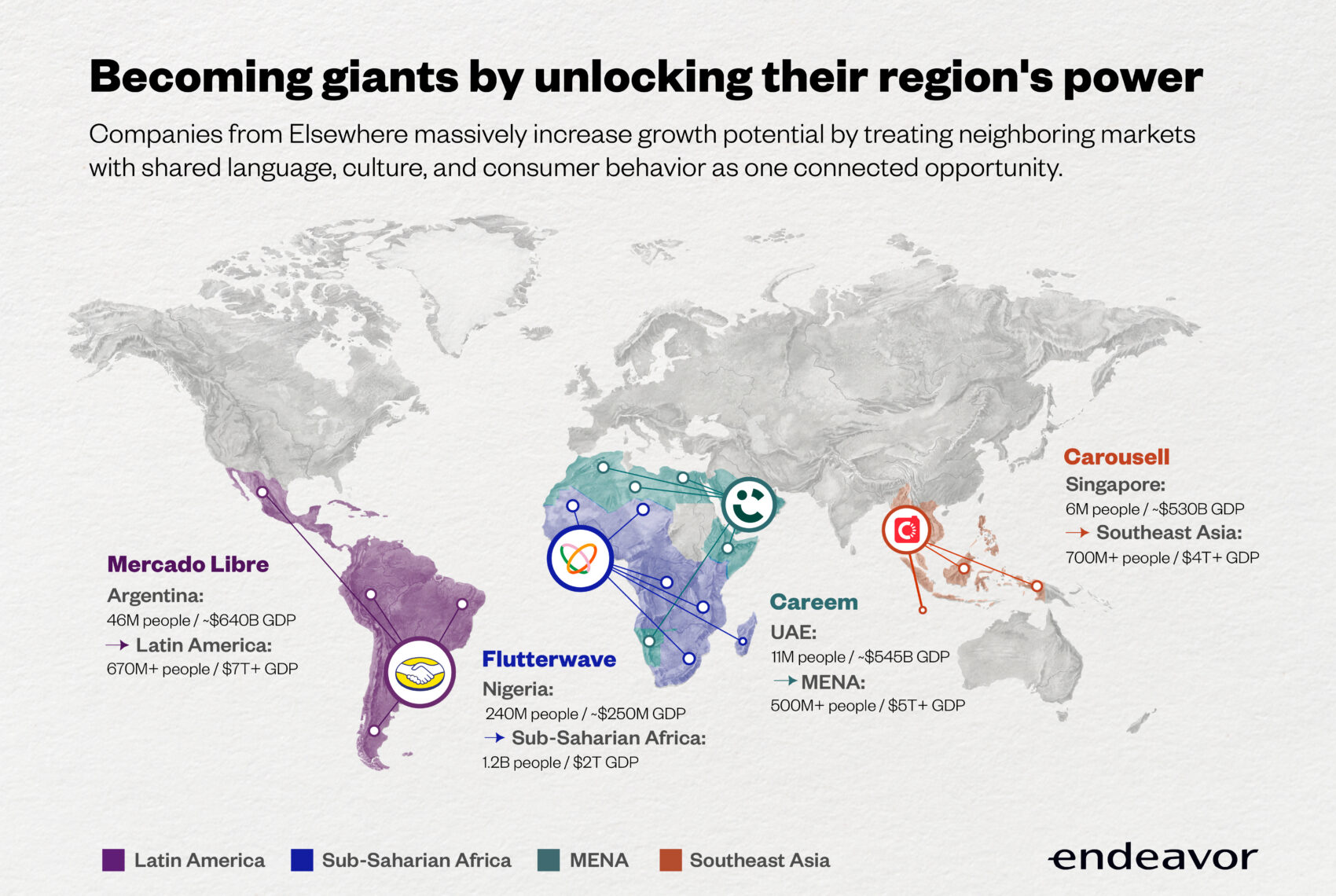
Some companies expand not by leaping across continents, but by moving deliberately across borders that already share something: economic ties, language, regulation, culture, or simply proximity. They grow outward to neighbors, building density while scaling and, many times, redefining entire regions.
Founded in Dubai in 2012 as a ride-hailing service, Careem was designed for the specific realities of the Middle East and North Africa: cash-heavy economies, fragmented transport systems, and cultural nuances bigger players often overlooked. The company grew to more than 70 cities across 10 countries.
By the time Uber acquired its ridesharing business for $3.1B in 2020 (the largest tech acquisition in the region at the time), Careem had changed how global investors perceived the MENA region: not as a collection of small, isolated markets, but as a cohesive opportunity. Careem alumni went on to found dozens of startups, with the 10 largest raising over $600M collectively, creating a Multiplier Effect that continues to shape the region’s entrepreneurial fabric.
One of the first Endeavor companies from Argentina, Mercado Libre took a comparable path in the early 2000s, expanding across the continent to become an $80B+ e-commerce and fintech powerhouse. Today, its co-founders reinvest in the region through mentorship and through Kaszek, a venture firm with approximately $3B in assets under management (AUM), pulling global capital closer and reinforcing Latin America as a unified innovation landscape.
" Shared language, cultural context, and similar market dynamics create a real advantage for founders scaling across a region. They’re often able to move faster and build with a level of local understanding that’s hard for outside players to replicate."
Nasim Novin
lead director of entrepreneur experience at Endeavor
Regional giants reframe what “total addressable market” actually means. A company operating across MENA, Southeast Asia, or Latin America is tapping into a combined population and economic significance that may rival or exceed the US or Europe, but with less direct competition. They also leave behind infrastructure — experienced operators, proven playbooks, and stronger investor confidence — that lowers the barrier to entering these regions and makes it easier for the next generation of entrepreneurs to build, get funded, and scale.
2. Elsewhere to Elsewhere: Scaling through complexity
When Airbnb wanted to expand into markets like Brazil, it faced an unexpected problem: most consumers didn’t have international credit cards. Payment methods varied widely. Fraud risks were different. The infrastructure simply wasn’t there. EBANX, an Endeavor company founded in Curitiba, stepped in to solve that. But like Airbnb, this challenge was faced by dozens of other companies. And like Brazil, the same friction existed in dozens of other markets.
Instead of growing only in Latin America and moving in a predictable path, EBANX expanded into Kenya, India, Türkiye, Thailand… places that, on the surface, share little in common. What connects them is structural: fragmented payment systems, low banking penetration, regulatory obstacles, and a growing base of digital consumers. EBANX built local operations in over 20 countries, forming partnerships, navigating compliance, and exporting knowledge developed in one context to unlock another.
This is a different kind of international expansion. These companies don’t follow geography, but patterns of complexity. They recognize that while markets may differ culturally, they often share behaviors. And once they learn how to operate in one, they can replicate that capability elsewhere.
Docplanner, originally from Poland, built a platform for booking medical appointments in systems where access is often fragmented and opaque. From Europe to Latin America, the health-tech startup expanded into countries where patients struggle to navigate care and providers lack digital tools to manage demand. Today, over 100 million patients use Docplanner each month across 13 countries.
" The best founders Elsewhere have already built through complexity and chaos."
Linda Rottenberg
co-founder and CEO of Endeavor
“When they expand, they often leverage that expertise and scale into markets with similar challenges,” Linda shares.
Founders in Elsewhere increasingly recognize in one another a peer or mentor, who faces similar operating realities, constraints, and opportunities. Markets that once felt distant start to look familiar, creating direct corridors for collaboration, expansion, and capital that no longer depend on traditional centers of gravity.

3. Elsewhere to everywhere: Born global with a home advantage
One of the oldest assumptions in tech is that, to be global, you must eventually leave home. But nowadays, some companies barely need to move at all.
Instead, they launch into the world from day one. When distribution is digital, demand is universal, and the barriers to entry across countries are low enough, it doesn’t matter where you’re from.
Take Airalo. Headquartered in Singapore, the leading eSIM marketplace works across more than 200 countries and regions and now serves over 20 million users worldwide. Another example, Headway Inc, was also able to reach massive scale from Ukraine: its suite of apps has surpassed 150 million downloads across more than 170 countries, with the majority of its revenue coming from the US.
Though both companies have a handful of offices in other locations for support, neither company needed to enter new markets in the traditional sense. Yet they compete directly with solutions born in more mature ecosystems.
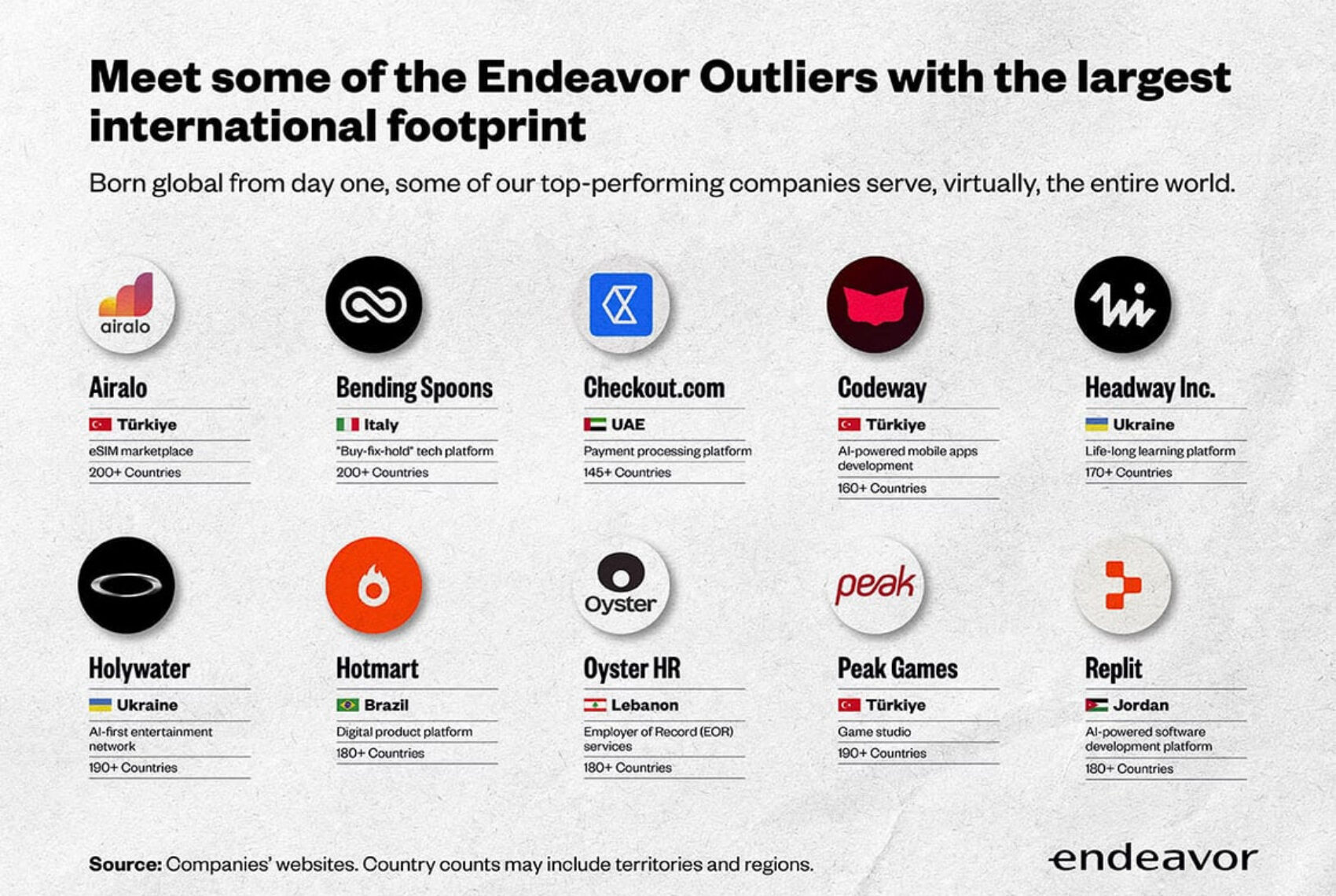
But what makes this pattern particularly powerful is what happens locally. Because these companies don’t need to relocate or fragment their operations to grow, they can stay deeply rooted in their original ecosystems — and invest in them.
Solidgate, a fintech company serving merchants across more than 150 countries, remains connected to their home country of Ukraine. It sponsors programming competitions, translates business literature into Ukrainian, and partners with universities to offer scholarships.
Meanwhile in Türkiye, Rina Onur Sirinoglu has focused on elevating other entrepreneurs with her. A co-founder at gaming successes Peak Games (acquired by Zynga for $1.8B) and Spyke Games, Rina has gone on to launch early-stage fund 500 İstanbul, investing in breakout Turkish startups, and mentoring founders across the region.
By staying anchored, these companies concentrate high-quality jobs, experienced operators, and global know-how in their ecosystems.
Featured Stories
Beyond Skyscrapers: What’s Really Powering Entrepreneurial Innovation in Dubai

Japanese entrepreneurs are leveling up: Endeavor CEO Linda Rottenberg explains how

The Collapse That Forced Proptech’s Boldest Founders to Reinvent Everything

Elsewhere, fintech is solving problems Silicon Valley never had


Related Articles
Beyond Skyscrapers: What’s Really Powering Entrepreneurial Innovation in Dubai
Japanese entrepreneurs are leveling up: Endeavor CEO Linda Rottenberg explains how
The Collapse That Forced Proptech’s Boldest Founders to Reinvent Everything