This entertainment industry is Elsewhere’s game
The global games market is worth more than $200B. From Turkish “testing mafias” to bootstrapped Vietnamese studios, here are the Elsewhere companies rewriting where we play.

Forget blockbuster movies. Forget smash hit songs. The biggest entertainment medium on the planet is gaming.
From its humble origins in arcades, the gaming industry has been taking a bigger slice of the lucrative business of entertainment ever since the rise of the smartphone and the advent of mobile gaming. In 2025, the global games market crossed $200B for the first time. That’s more than the global box office and recorded music combined… times three.
But while film and music — like entrepreneurship — too often feel centered in California, gaming has never been tied to one particular place. 50% of the gaming market is mobile, and does not require one of the legacy studios out of China or the US to build, scale, and succeed. With the help of democratized platforms that offer global access to every game, hubs in Elsewhere markets are springing up to dominate the gaming industry.
Take a look at your phone, and chances are you’ll already have a game downloaded that was built and distributed in Türkiye, Vietnam, or another country far from Silicon Valley and Los Angeles. The secret sauce that makes these companies work is a combination of mentorship, talent, local expertise, and just a dash of AI.
Türkiye’s testing expertise: Less gameplay, more playbook
“I started Peak to change the world,” Sidar Şahin, founder and CEO of Peak Games (and an Endeavor Entrepreneur), told the Wall Street Journal in 2012. “In Türkiye, there is no ecosystem. It has just started. Yes, there is a big potential… It is not there yet.” Sidar’s vision was that Peak, like PayPal, could create a “mafia” of future entrepreneurs: “We take people in and train them. Then they become leaders and go on… I want a ‘Peak Games mafia’.”
Nearly 15 years later, his ambition has come true. Türkiye’s entrepreneurial ecosystem is thriving, with a range of splashy successes — including Peak Games’s own $1.8B acquisition by Zynga in June 2020. But just as Sidar predicted, Peak Games built more than one successful company: it built a dominant global gaming hub, courtesy of the Peak Games mafia.
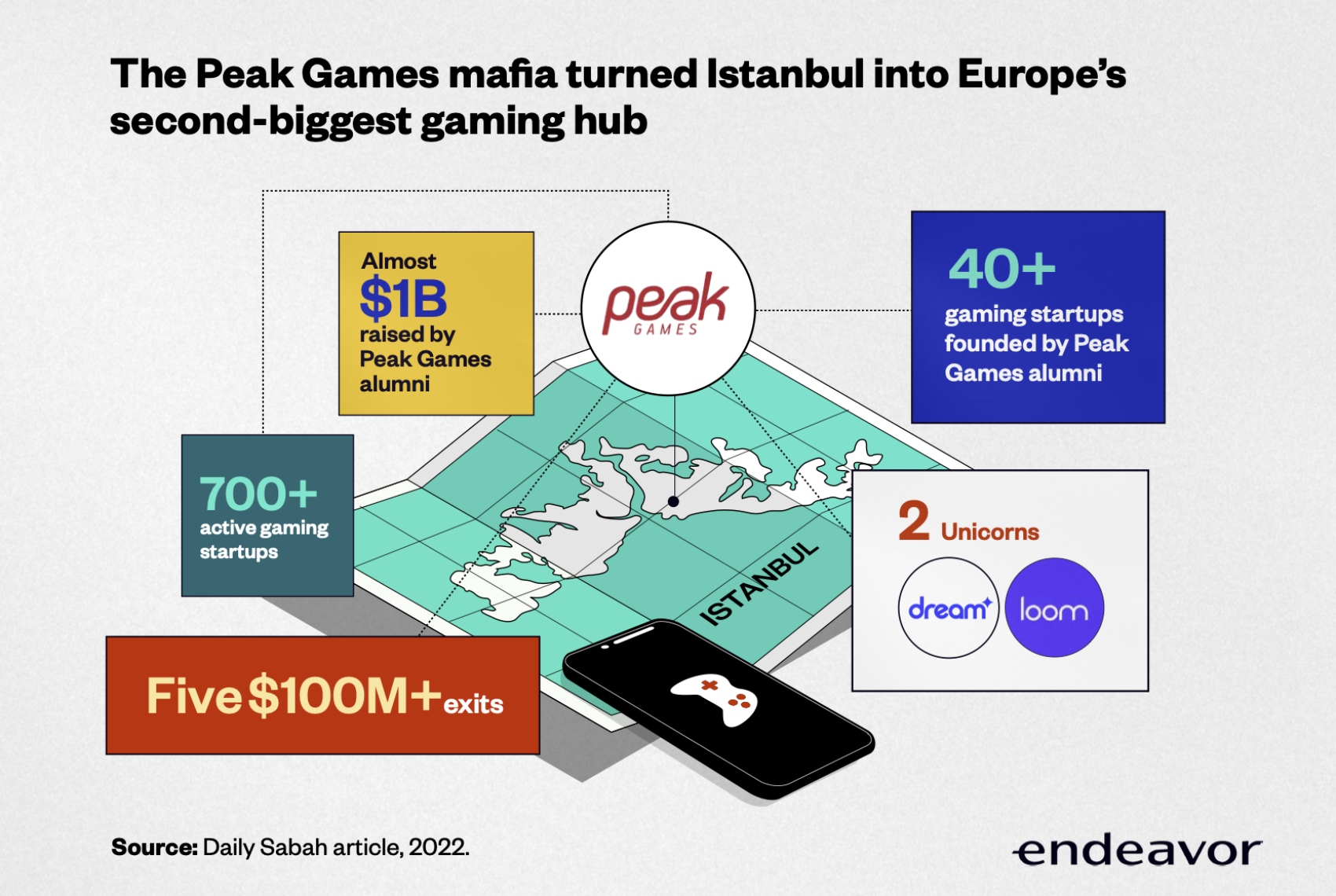
Alumni from Peak Games have founded 40+ gaming startups and raised almost a billion dollars. Dream Games raised $468M over multiple rounds and created Royal Match, the game that dethroned Candy Crush globally in both downloads and revenue in 2023. Spyke Games, led by Peak Games’ co-founder and Endeavor Entrepreneur Rina Onur, raised a record-breaking $55M seed round.
Genre expertise has been key to the success of gaming in Türkiye. Turkish gaming studios focus on casual puzzle games, a specific niche that they execute better than any other global player as a result of their intense emphasis on testing.
“They’ve cracked the user acquisition engines that fuel this model,” explained Carlos Romero Jantacomma, Manager of Entrepreneur Selection at Endeavor.
“They can test and measure user interactions by adding and taking out features on a daily basis, which you can’t do for a software or consumer company,” Carlos said.
“Depending on what kind of user they think you are, we can have slightly different versions of the same game. Or if they’re testing a potential future gameplay loop, they create a mini-game within an existing game, and if people really love it they can spin it out into a whole new game — which is what Spyke Games did for their second title.”
Sharing this playbook with other founders is the Multiplier Effect at work, where one entrepreneur’s work inspires, educates, and uplifts their peers. As Peak Games alumni created their own companies, they brought Peak’s institutional knowledge and strategy with them.
The result is an ecosystem that has continued to flourish. Today, Istanbul is Europe’s second-largest gaming hub in terms of studio density (after London), with two unicorns, 700+ active gaming startups, and five $100M+ exits.
The Vietnamese underdog: Going global with local passion
In 2013, a 28-year-old independent developer named Dong Nguyen spent a weekend building an uncomplicated yet addictive game that asked users to keep a gravity-challenged bird in the sky. At first, he called it Flip Flap; then, realizing that another app had the same name, he changed the title to Flappy Bird. The rest is history.
After slowly rising on the App Store for over six months, in January 2014, Flappy Bird became the world’s most downloaded free game, spawning thousands of competitors and knock-offs. At the height of Flappy Bird’s popularity, Nguyen himself earned $50K a day from in-app advertisements and sales. Just a month later, the creator pulled the game from the App Store, struggling with the personal criticism and public attention he’d received in the wake of his success.
Flappy Bird’s virality marked a turning point in mobile gaming history, and illustrated one of the keys to Vietnam’s mobile gaming success: passion. Like Nguyen, who was an obsessive Super Mario Bros. fan growing up, many of Vietnam’s game developers are fervent players themselves.
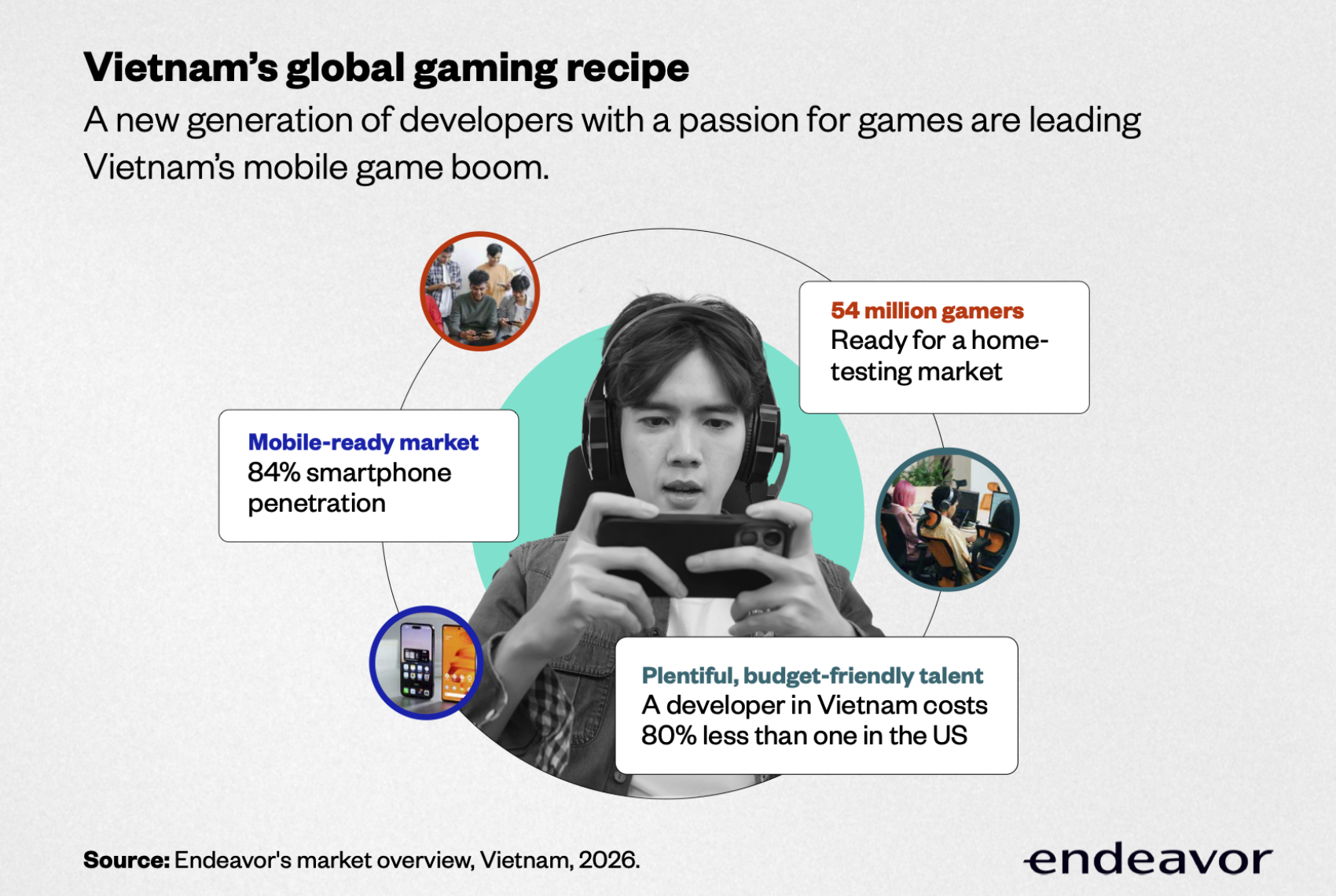
Today’s new generation of developers are also increasingly attuned to mobile gaming itself. Smartphone penetration is at more than 80% in Vietnam, well above the global average, and the country has a base of 54 million gamers, making it ideal for a home testing market. And due to a wealth of local talent and smaller salaries (a developer in Vietnam costs up to 80% less than one in the US), development cost is a fraction of what American or European studios pay.
The result of these factors is a range of success stories launching from Vietnam. Athena Studio — led by Luke Nguyen, the winner of the 2025 Endeavor Linda Awards — has seen over 10 million users spend two billion hours playing their portfolio of titles. Amanotes, a mobile music game developer and publisher, has become the number one music game publisher worldwide, with more than 3.5 billion cumulative downloads and 70 million monthly average users. And they’ve done it entirely bootstrapped, reaching high profits with no outside funding. iKame Global, another Endeavor Entrepreneur-led company, followed a similar path, scaling without outside capital; in 2025, they generated nearly $200M in global revenue from a single game.
Profitable and global from day one, these studios have brought longevity and sustainability to Flappy Bird’s initial proof of concept.
An industry made for Elsewhere… and AI
Unsurprisingly, AI has changed the nature of the gaming industry. The number of games released right now is higher than ever, due to AI’s democratization of development. One expert predicted that by 2028, half of the new games on digital game distribution platform Steam will be created by AI.
“I could vibe-code a game and launch it on the app store tomorrow, and I have zero technical ability,” agreed Carlos. “Will it be good? Probably not. But I can do it.”
Across platforms, AI is increasing supply, but not necessarily quality, and some gamers have proven adverse to its influence. Steam has started actively labeling which elements of a game were created with the help of AI in order to give players more transparency. But Carlos points out that for a quality studio with good developers, AI simply supercharges their ability to make games, speeding workflows and reducing labor.
Türkiye has also proved that another crucial factor for Elsewhere gaming success lies in data. AI can boost anyone’s data-crunching ability no matter how strong, distilling user patterns and offering the opportunity to not just A/B test but A/B/C/D/E/F/G test.
“These studios have been using machine-learning algorithms for a long time to test different outcomes,” Carlos explained. The proliferation and strength of new generative AI models means that Elsewhere ecosystems that were already experts at data testing have been handed a whole new tank of fuel.
That fuel is necessary because, like in too many other industries, there’s still a capital gap between gaming startups building Elsewhere and those in hubs like Silicon Valley or China. But in gaming, that gap has become part of the advantage. Founders are building profitable companies earlier, creating their own playbooks, and turning local talent networks into global engines. From iKame and Amanotes to Peak Games and its successors, they are proving that the next gaming empire does not need to be built in the usual places.
Featured Stories




Unicorns aren’t the end of an ecosystem’s success. They’re the beginning.