Trust Compounds Faster Than Money
In a world where capital flows freely, the most valuable currency is something else entirely.
Here at Endeavor, you can’t go five minutes in one of our International Selection Panels without hearing someone ask potential candidates the question of our time.
“What is your AI strategy?”
Now, that’s an important one. But Linda Rottenberg, our co-founder, has begun asking something else entirely: What’s the most human thing you’re doing, now more than ever?
While algorithms dictate who we listen to and founders are constantly asked to optimize, automate, and accelerate, her question reminds us that entrepreneurship remains a deeply human domain. And at the core of that humanity is one word: trust.
That’s why, as we revisited our vision for 2035, we realized what defines Endeavor most. We are, and always have been, a Network of Trust.
Here’s why we’re proud to be a Network of Trust, and why you should invest more in yours.
1. Being in the right circle matters more than geography
Marc Andreessen, the legendary investor, recently said that AI “slammed” everything back to Silicon Valley. We beg to differ.
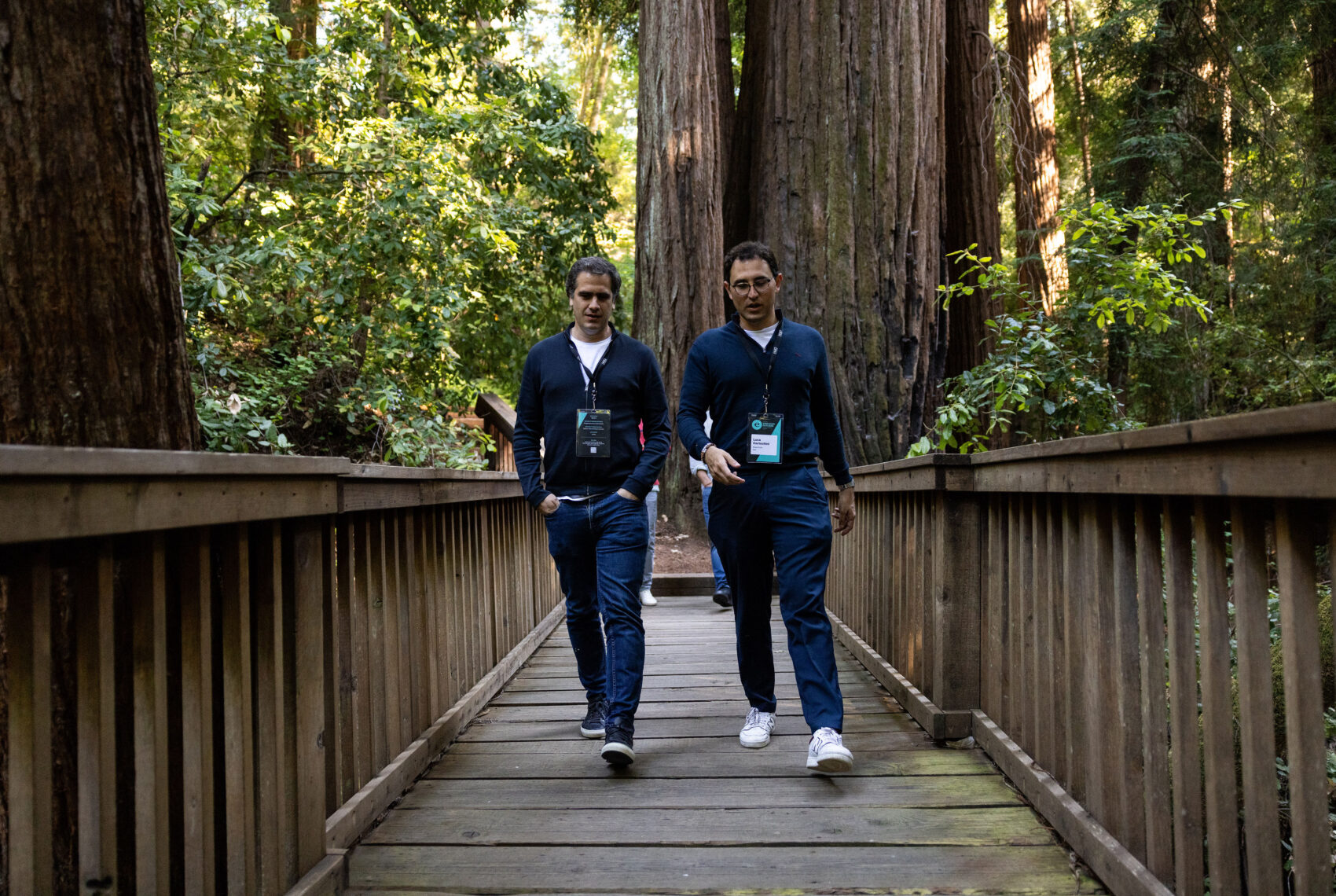
During our recent Outliers Retreat — a three-day event where a selection of our top-performing founders pause, reflect on their challenges, and learn from each other — we welcomed 110 Endeavor Entrepreneurs to Comporta, a small village in Portugal. Representing more than 35 countries, from Indonesia to Chile, their physical location was never a barrier to success; the companies they lead have raised a total of $42B in the last three years.
We believe that being in the “right place at the right time” only takes you so far without a deep layer of trust. Yet magical things happen when you’re in the right circle.
Circles of trust are what allow Endeavor’s geographically distributed community to spark connections that could shape the future of their companies. Across borders and time zones, trust allows a founder in Iraq to meet their role model from Southeast Asia, or two entrepreneurs with shared visions in North Africa and Latin America to build a shared journey.
Take Amr Shady and Stefan Moller. In 2022, Amr and Stefan met during an Outliers Retreat in Scotts Valley, California.
Amr founded Tribal Credit, a fintech providing corporate cards and financial solutions for companies in the Middle East and LatAm. Stefan founded Klar, a Mexico-based digital bank now valued at almost $800M that had been wanting to expand into the SME territory Tribal already knew so well. Amr, who also chairs Endeavor Egypt’s board, was looking for advice from Stefan. They created an instant bond.

Fast forward to a lunch we hosted in San Francisco last year, and a simple “How are you doing?” evolved into an open, strategic conversation about the synergies and opportunities between their companies. As they talked, it became clear how well their strengths complemented and compounded each other — from market knowledge to product capabilities.
The result? Klar acquired Tribal Credit’s assets in Mexico in December 2024. A deal driven not by numbers, but by trust:
" Without the circle of trust that Endeavor fostered, I would have never had the opportunity to meet the brilliant Amr. And without that connection, this transaction simply wouldn’t have happened."
Stefan Moller
Endeavor Entrepreneur and founder of Klar
Proximity helps build trust, but it’s neither a condition nor a guarantee. Once trust is in place, what happens next is no longer bound by geography.
A few years ago, Allen Taylor, Managing Partner of Endeavor Catalyst, wrote that everything would move to Zoom. “I argued that we would live in this geographically independent world. That wasn’t exactly right,” he reflects.
" What we're learning in a post-COVID world is that although we have new tools for working globally, we still have these important hubs and nodes where humans gather. Because we need community, and we need to gather in person. What Endeavor does is facilitate spaces where trust flourishes."
Allen Taylor
Managing Director of Endeavor Catalyst
2. Playbooks may offer paths, but peers light the way
In Comporta, one of the sessions was an off-the-record conversation with Carlos García Ottati, founder of Kavak, a $2.2B used-car platform operating across Latin America and Asia.

Carlos shared the unfiltered version of his journey: the investor pressure, the operational hurdles, the toll of leading through hyperscale.
" It was such a raw and honest conversation. In these settings, founders feel like they can take off their hero masks and be humans. They're real with each other because they know that other people in the room have been through their own highs and lows."
Nasim Novin
Senior Director, Entrepreneur Experience at Endeavor Global
This is the power of trust. When founders trust each other, they share their failures openly and celebrate their wins humbly. Personal stories carry lessons deeper than “here’s what you should do”. Lessons travel further when there’s no agenda –just mutual respect and genuine willingness to support. Peer-led spaces like these don’t just build knowledge. They build confidence, courage, and the kind of relationships that can shift the course of a business.
3. Trust compounds in ways that capital cannot
We’re privileged to say that our rules-based venture capital fund, Endeavor Catalyst, often has access to highly competitive rounds — and we truly believe it has nothing to do with money. Founders don’t need an extra $1M when they’re raising $250M and already oversubscribed, after all. They need what Endeavor offers: a Network of Trust.
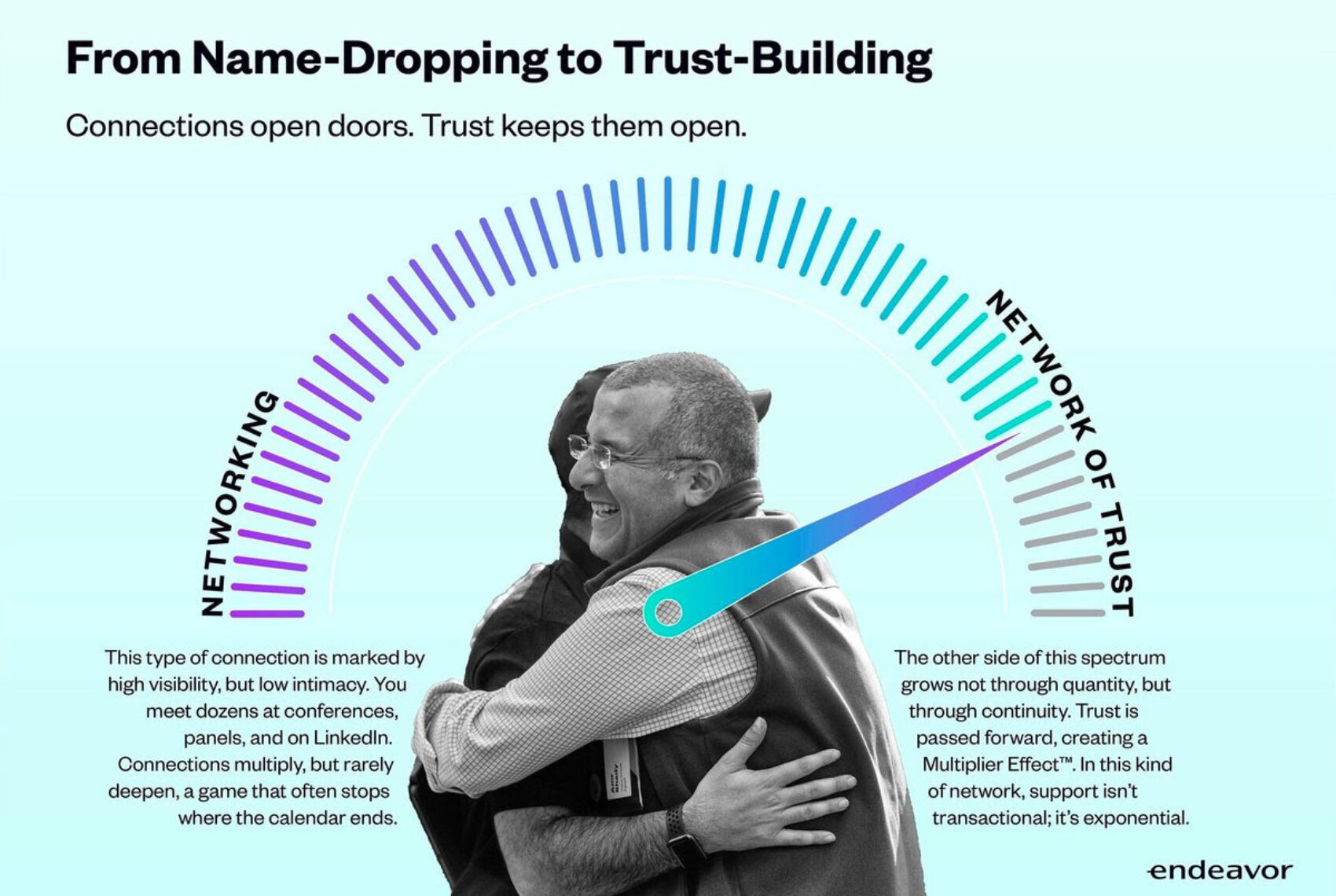
The Multiplier Effect™️ — the collective impact of entrepreneurs in their ecosystem when they go on to support the next generation — runs on deep, pre-existing relationships. That’s why entrepreneurs who come from “founder factories” or have a tight peer community tend to grow faster and more efficiently: trust is a decision-making accelerator.
They are surrounded by people who’ve walked the walk and can help them follow similar footsteps through knowledge and further connections. And the more these nodes generate other nodes, the more they mentor and support each other, the more the ecosystem benefits.
In a world of deepfakes, AI disruption, and fractured systems, trust has become this generation’s most important currency. And like any currency, its value grows when it’s exchanged — not hoarded.
Whenever Linda sees entrepreneurs or VCs in emerging markets pushing non-disclosure agreements (NDAs) and non-competes, or discouraging their teams from networking, she asks:
“Would you rather model yourself on Silicon Valley or Route 128?”
The response is almost always, “What’s Route 128?” And that’s the whole point.
Route 128 is the highway surrounding Boston’s suburbs. Between the 1960s and 1980s, it dominated tech, hiring three times as many tech workers as Silicon Valley. But instead of creating an entrepreneur-breeding ecosystem, they tried to stamp out competition by creating vertically integrated firms, discouraging peer networking, and deploying NDAs and non-competes. Route 128 was built on a lack of trust, and when the 1990s recession hit, the “Massachusetts Miracle” ended. Meanwhile, Silicon Valley thrived on open networks and shared circles.
Our invitation is simple: think about trust as equity, and start investing in it. What circles are you in? Who do you call when you need the most honest answer? How many of your LinkedIn connections do you truly know? How much do you share with others simply because it might help more people?
Build those circles well, and you’ll never grow alone.
Featured Stories


Unicorns aren’t the end of an ecosystem’s success. They’re the beginning.