The New Wartime CEO
What it takes to lead when volatility becomes the baseline.

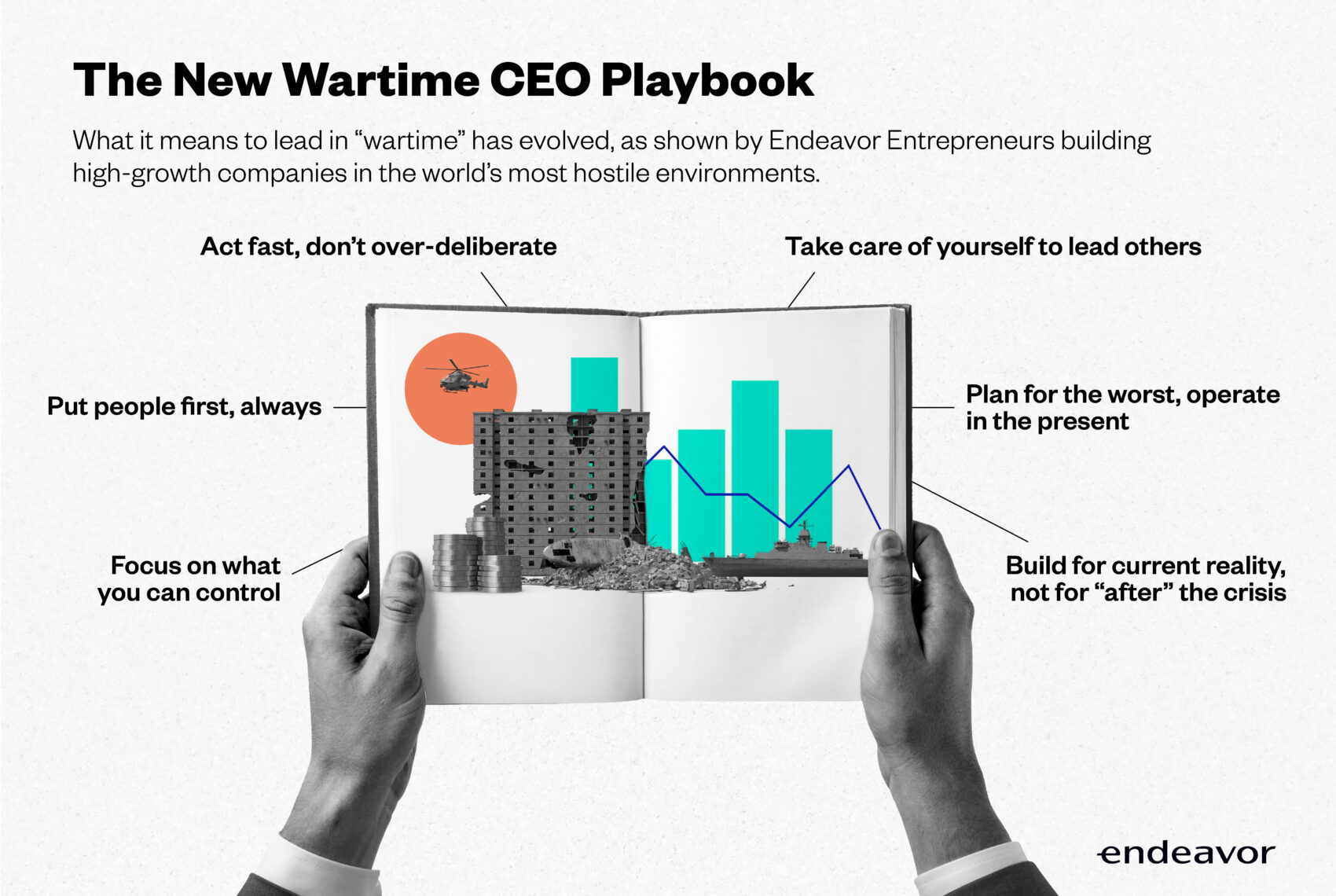
Leadership can feel like two entirely different jobs. As Ben Horowitz puts it, in “peacetime” a company has a large advantage and the CEO can focus on scaling what works. But when an existential threat emerges, that same role turns into “wartime”: decisions get faster, stakes get higher, and survival is the priority.
But if Horowitz had been born in São Paulo, “he’d realize that there’s no such thing as a peacetime CEO in Latin America,” according to Sergio Furio of Creditas. Having scaled one of the most successful fintech unicorns in the region during periods of economic turbulence, the Endeavor Entrepreneur explains: “There’s always a crisis in Latin America. That’s probably the beauty of it.”
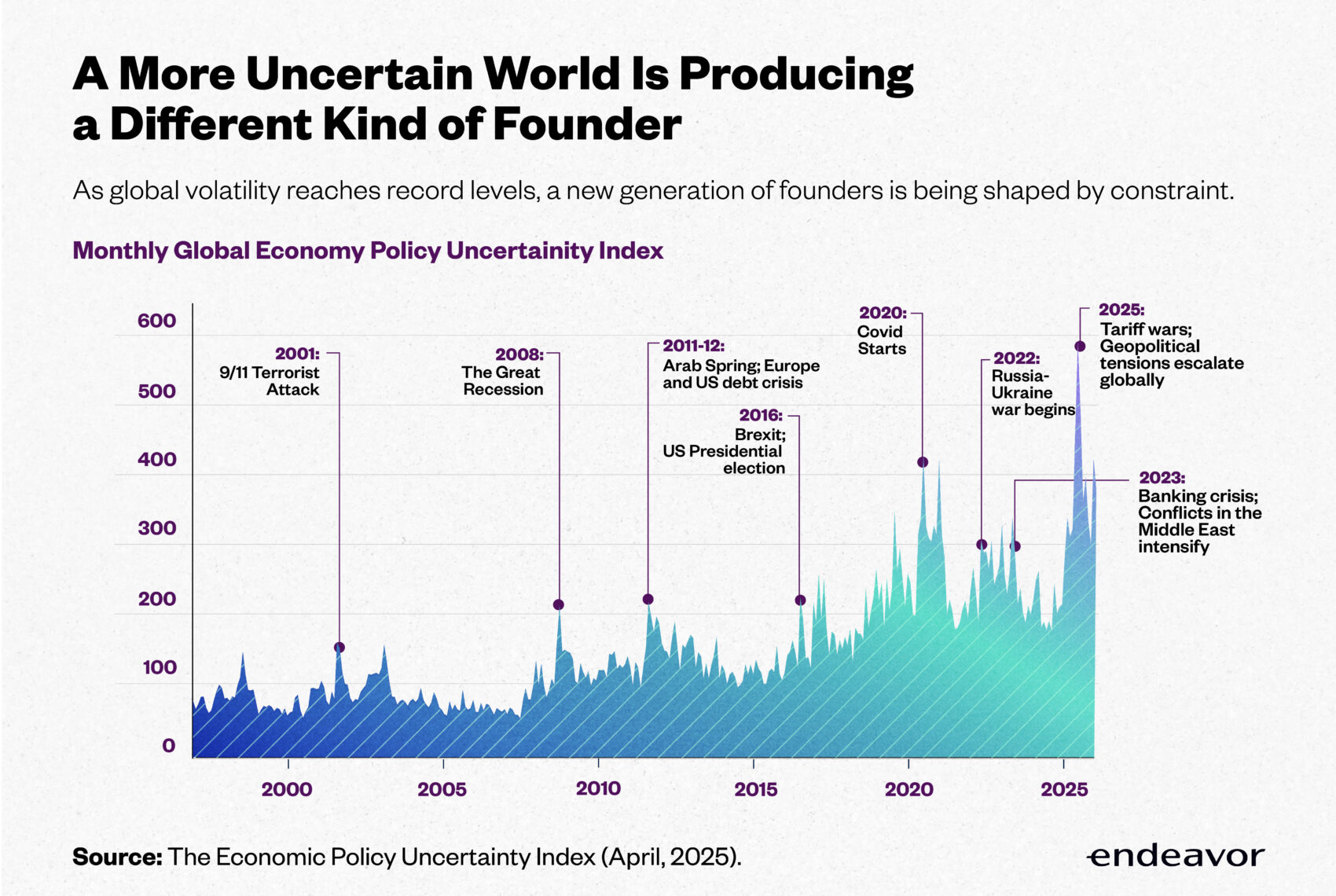
For years, the wartime side may have been dormant for CEOs building in mature ecosystems that often take stability for granted. However, inflation spikes, geopolitical tensions, supply chain shocks, and economic uncertainty are turning volatility into a global baseline. The question is no longer whether entrepreneurs will face disruption, but how they operate within it.
In many ways, founders Elsewhere — markets outside Silicon Valley and global tech hubs —, who have built through chaos for decades, are ahead of the curve. And they have developed behaviors that, especially now, many more entrepreneurs can learn from. So we turned to our community to answer: how do some of the best founders Elsewhere show up as leaders when it matters the most?
1. What do they do in the first 48 hours?
When Russia invaded Ukraine in February 2022, Roman Prokofiev was on a train on vacation with his family. The Endeavor Entrepreneur woke up at 4 am that Thursday surrounded by uneasy murmurs and soon learned war had started. Within two hours, he wrote to all Jooble employees on Slack: “Forget about work and get to safety. Stay online. We will help.”
By 9 am, he had set up a “safety office” to help people relocate, find transportation, and accommodation.
“The best thing is to act, not deliberate too much. No one knows what may happen anyway,” shared Anton Pavlovsky, Founder of Headway Inc, who immediately flew from his base in London back to Ukraine to help move his local team into a hotel in a safer area.
Bias for action and moving quickly with incomplete information is a defining trait of great entrepreneurs, regardless of geography or circumstance. But most importantly, prioritizing people under pressure is what creates trust, strengthens loyalty, and builds momentum to unlock the next steps.
The entrepreneurs mentioned they saw other companies were more worried about calling potential clients, or paying dividends to shareholders first, then claiming they didn’t have money to support anyone. “It was an easy decision to focus on our team,” Ramon said. “Our business is our people anyway. What else is there to think about?”
The Ukrainian companies that prioritized people saw extraordinary results: The lifelong learning platform Headway Inc’s team grew by 90%+ in 2022, while Jooble, an AI-driven job search engine, saw its Net Promoter Score (NPS) rise from 40 to 64, a key market-research measure.
2. Do they act like martyrs or donors?
When hit by a big challenge, leaders inevitably move through phases similar to the five stages of grief: denial, anger, bargaining, depression, and acceptance. The goal is to progress toward acceptance as swiftly as possible. Then, to help others do the same.
The concept of martyr and donor was brought by a psychologist Anton invited for a talk with the Headway Inc team. He proposed: if you give all your blood at once, you’re gone. If you give some consistently, however, you can contribute indefinitely.
If there’s too much going on and it seems like everything needs attention, it’s easy to neglect your own well-being and fall into bad habits, like doomscrolling through the news or losing sleep. But entrepreneurs should be putting their oxygen masks on first.
This is how Tamim Khalfa, co-founder and CEO of pioneering Lebanese delivery app Toters, was able to cope with a series of back-to-back crises — from the country’s financial collapse to the COVID-19 pandemic and the explosion at the port of Beirut.
He needed consistency in some form. That turned into listening to two Masters of Scale podcast episodes a day, working out for 30 minutes each morning, and eating healthier. “At first, I fell off the pull-up bar in my home a few times,” Tamim admitted. “Now, when I get to the office, I feel much stronger. To be resistant to daily challenges, you need to start from within. Building a routine gives us some control when everything outside is out of our control. If more shock waves come our way (and they always come), I’m ready.” As Vera Abouchar, our managing director in Lebanon, told us recently, “[the Toters founders] have become experts in leading and scaling through crisis, across different levels of uncertainty.”
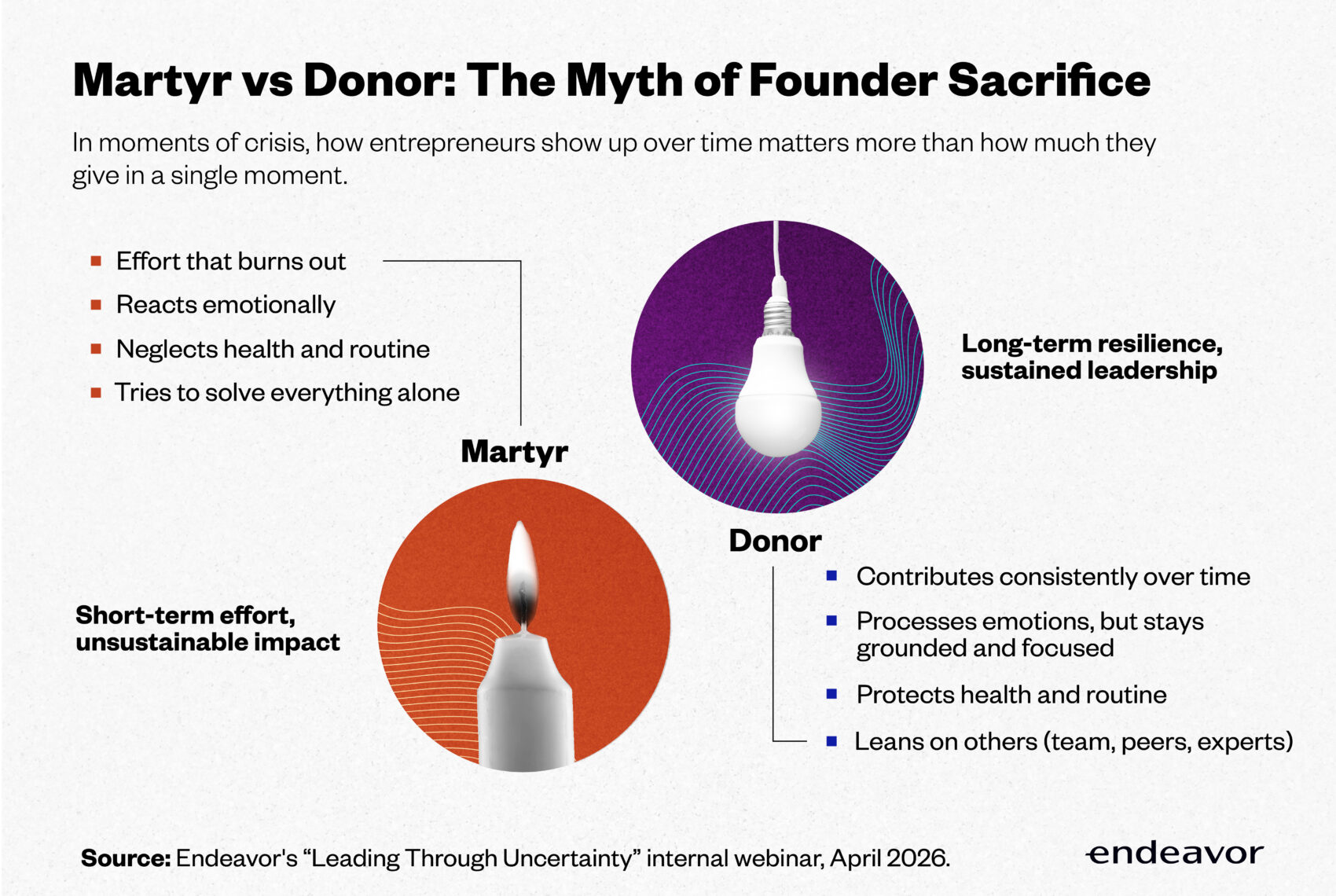
When assessing entrepreneurs, understand: are they open to talking things through? That can be within the company, within a trusted peer community, and with a professional, one-on-one.
Do they pay attention to their sleep, nutrition, hydration, exercise, and their general well-being? A healthy body is a healthy mind, and that always reflects on the company.
3. Do they assume things will just go back to normal?
Roman passed on a message to his team: Imagine the war never ends. For the rest of your life. Act as if it’s just part of our reality.
“When I wrote this, my team thought I was a bit crazy,” he admitted.
Roman didn’t want to see notes or documents planning initiatives for “after the war,” because no one knew when that would be. Four years later, it’s still going on — and if everyone waited for the conditions to be perfect, nothing would have gotten done.
It’s the leader’s responsibility to balance empathy and pragmatism. Entrepreneurs need to give people hope, but also help them see things won’t necessarily go back to the way they were, especially since the ecosystem is ever changing.
“We saw a lot of stress and volatility in 2009 and 2014, so we’ve always had a good financial cushion,” Roman explained. At Jooble, the rule is to have at least six months of runway at all times, so they acted preemptively and reached out to clients, who usually have 60 days to pay their invoices, to ask them to pay right away if they could. About 75% did — and then they never had to ask again. “I didn’t want them to be with us only because we are from Ukraine. We were back to business as usual.”
Recently, Sary Azakir, co-founder of GCC healthcare fintech platform Toothpick, faced a similar situation with teams split between the UAE and Lebanon after the latest US-Israeli war on Iran escalated. “We are not used to this here in Dubai, but our team in Lebanon has lived through uncertainty before. So the priority was to stay calm, communicate clearly, and start planning for every possible scenario”.
Ultimately, staying cool in adverse moments comes down to disciplined, clear-eyed leadership — one that hopes for the best and plans for the worst. It means accepting reality early and making difficult decisions when needed, whether that involves taking risks or making cuts to ensure the business remains viable in the long term.
The key question is whether founders are waiting for things to return to normal, or already operating under the assumption of permanent disruption. This mindset shift sets the tone for the organization, helping teams stay focused, aligned, and effective even in uncertainty.
Chaos, when met well, becomes a forcing function. A friend. It strips away vanity metrics, exposes weak foundations, and accelerates trust. Elsewhere founders have leveraged it for decades: between 2012 and 2018, our co-investment fund Endeavor Catalyst invested in six companies in Türkiye. The country was in the midst of a currency collapse, but those investments returned 11x on every dollar. Our investments in Argentina during its economic crisis yielded nearly a 5x return.
The irony is that the best wartime CEOs are often the calmest ones in the room. Elsewhere entrepreneurs have reframed the concept. They don’t confuse urgency with panic, or survival with short-term thinking. If anything, operating in constant volatility forces a kind of clarity. Now, founders everywhere are being forced to build the same muscle.
Featured Stories
The Collapse That Forced Proptech’s Boldest Founders to Reinvent Everything

Elsewhere, fintech is solving problems Silicon Valley never had


Related Articles
The Collapse That Forced Proptech’s Boldest Founders to Reinvent Everything