Ten Outliers Building for Broken Systems
The top 10% of Endeavor’s community are Outliers, best-in-class companies shaping the future of entrepreneurship Elsewhere. Here are 10 who saw opportunity in the issues affecting their homes.

Remote
The COVID-19 pandemic revealed dozens of faultlines across our society, from logistics to education and even work itself. Remote work offered opportunities (flexibility, accessibility, greater access to global talent) but also a host of challenges, including compliance with local labor laws, setting up local entities, navigating payroll and benefits systems across borders and more.
Into the gap stepped Remote, a Lisbon-based HR startup that operates its own legal entities in 100-plus countries and uses AI to create a full-stack solution for remote employees. And far from being restricted to a pandemic use case, Remote proved how crucial access to global talent can be: it now works with companies including Nubank, Grab, Maersk, and thousands more to manage global employees and contractors, fully compliant with local regulations. Remote reached a $3B valuation in 2022 after a $300M Series C led by SoftBank, and they continue to simplify international employment every day, everywhere.
Marcelo Lebre, Remote’s co-founder and president, became an Endeavor Entrepreneur in 2025. The same year, his company qualified as one of Endeavor’s Outliers: the annual program that celebrates and supports the top 10% best-in-class companies in Endeavor’s portfolio. An Outlier again this year, Remote is also not alone in seeing an opportunity in global broken systems.

Marcelo Lebre, Remote’s co-founder and president, became an Endeavor Entrepreneur in 2025. The same year, his company qualified as one of Endeavor’s Outliers: the annual program that celebrates and supports the top 10% best-in-class companies in Endeavor’s portfolio. An Outlier again this year, Remote is also not alone in seeing an opportunity in global broken systems.
“Almost every Endeavor Entrepreneur could be on this list — it’s at the heart of the work Elsewhere founders are doing,” said Nasim Novin, Lead Director of Entrepreneur Experience at Endeavor.
“They’re uniquely positioned, on the ground, with knowledge of their local systems. We’re highlighting a few key Outliers tackling some of the biggest problems in their market. The infrastructure players — Flutterwave, Rain, Alpaca — also enable a range of other companies to spring up in their wake, because once they’ve fixed the main issue, there are a host of other potential products and solutions.”
From pandemics to failing financial infrastructure, from cross-border complexities to credit systems, these Outliers are first responders on the faultlines.

Rain
Stablecoins — a type of cryptocurrency backed by traditional assets like the US dollar — are a big new player in Elsewhere economies. In Latin America and Africa, stablecoins have grown 40% year-over-year compared to just 4% in North America. That’s because what could be an investment strategy for people in more advanced economies, is for other countries a way to access a stable currency at last. When currencies fail or economies undergo crises, stablecoins offer a rope out of the quicksand. We’re seeing this in countries like Argentina, where inflation reached 118% in 2024, and stablecoins accounted for over 60% of all crypto trading volume that year.
Founders Farooq Malik and Charles Yoo-Naut have watched this growth up close. Their company, Rain, is based in New York with core operations in Puerto Rico, but 70% of their clients are in Latin America, using Rain as a solution for currency volatility or inefficient and untrustworthy traditional banking. In 2025, Farooq and Charles became Endeavor Entrepreneurs, and they started 2026 with a bang, hitting a $1.95B valuation with a $250M Series C led by ICONIQ and participation of Endeavor Catalyst.
Providing businesses with the infrastructure they need to issue and manage stablecoin-linked cards and wallets, Rain has seen their active card base increase 30x and their annual payment volume increase 38x times in the last year. This year, Rain also became an Outlier for the first time.
Alpaca
In 2013, stock trading changed. The launch of Californian fintech Robinhood meant it wasn’t just a field for Wall Street suits anymore — but accessible to anyone with a smartphone. Robinhood was followed by a wave of fintechs worldwide who wanted to offer the same option to their respective geographies, democratizing trading and enabling customers in underserved regions to gain new, previously impossible levels of financial access.
The best of the best became Endeavor Entrepreneurs, including Canadian neobank KOHO, Egyptian trading platform Thndr, and Türkiye’s Midas. Alongside their origin story, these three companies share another commonality — their trading functionality is all based on infrastructure provided by Alpaca.
A Japanese-founded API provider, Alpaca enables developers and entrepreneurs to launch and scale products for trading assets including stocks, bonds, crypto, and options. Facing backend brokerage issues directly, Alpaca supports over 300 companies in 40 countries and processes millions of transactions. In 2025, Alpaca founder Yoshi Yokokawa became an Endeavor Entrepreneur. In January 2026, his company raised $150M in a Series D, hit a new valuation of $1.15B and became the first Japanese-founded fintech unicorn — as well as one of Endeavor’s Outliers.

Flutterwave
In 2016, Africa’s digital payment ecosystem was flourishing but highly fragmented. Consumers used a range of different payment methods beyond the typical card payments, which added an expensive burden to merchants who needed to integrate with multiple payment service providers and banks in order to accept payments. Then came Flutterwave.
Founded by Olugbenga “GB” Agboola — who became an Endeavor Entrepreneur in 2019 — in Nigeria, Flutterwave’s solution was an API that made it easy for merchants to accept any payment method and a one-stop mobile wallet app for consumers. The company changed Africa’s financial landscape and became Africa’s largest fintech, holding Outlier status since 2020.
Powering local and cross-border payments across more than 30 African countries, Flutterwave is worth more than $3B and shows no signs of slowing — in fact, the company kicked off 2026 by acquiring open banking startup Mono in its ongoing mission to support Africa’s fintech growth.
LemFi
People from the African diaspora send over $5B in global remittances back home every year. But for a long time, the diaspora also had to spend much more, paying high fees to remittance middlemen. Ridwan Olalere had spent two years at the African fintech giant Flutterwave building the infrastructure that enabled companies like Uber and Spotify to accept payments across Africa; he also worked on a remittance product that never quite took off, partially because of high fraud. Ridwan wanted to provide reliable, low-cost payments, settled speedily and directly into the recipient’s preferred payment method.
Eventually, Ridwan realized this product was too big to sit under another company’s umbrella. It needed a home of its own.
He founded LemFi in 2021 and became an Endeavor Entrepreneur in 2024. Since then, Lemfi has attracted over two million registered users in diaspora communities across Europe, North America, and, most recently, Australia, sending well over $1B monthly to emerging markets including China, India, Kenya, Nigeria, and Pakistan. In 2025, LemFi became an Outlier.

Cashea
In Venezuela, everyday access to consumer credit had all but disappeared due to inflation controls and economic instability. Cashea set out to change that, enabling consumers to split purchases into short-term and interest-free installments across thousands of retail partners.
At Endeavor’s 2025 International Selection Panel (ISP), where shortlisted candidates who dream of becoming Endeavor Entrepreneurs are interviewed by a panel of experts, Cashea stood out. “They represent more than just a company but the rebirth of an old country,” said Mariano Gomide de Faria, co-founder and co-CEO of Brazilian multinational cloud commerce company VTEXT. Founders Pedro Vallenilla, Ramón Lange, Nicolás Curat, and Arnoldo Gabaldón became Endeavor Entrepreneurs — and their company Cashea became an Outlier the same year.
It is now one of the biggest buy-now, pay-later players in Latin America, processing transactions equivalent to 3% of Venezuela’s GDP, at an average of one per second.

Property Finder
In 2005, the UAE’s real estate market was entirely offline. Property listings were printed in the classifieds, or new arrivals had to roam around looking for “For Sale” or “To Rent” signs. Regional internet penetration was at just 40%. But Michael Lahyani could imagine a better, more accessible world: easy access to listings, especially online — something that would become crucial for a city that has drawn so many expats.
To create it, he launched Property Finder, which brought the real estate market into the digital world, sometimes even by singlehanded onboarding one real estate agent at a time! Michael became an Endeavor Entrepreneur in 2013, as Endeavor Dubai’s first selected company, and Property Finder was an Outlier for the first time in 2018.
Today, Property Finder is one of the largest real estate platforms in the Middle East, expanding into Saudi Arabia and Türkiye, as well as its UAE home. In 2025, it announced a new $525M investment led by Permira.

Overhaul
Like Remote, Overhaul is operating to solve issues in an industry COVID-19 laid bare — in this case, supply chains. From healthcare to consumer goods, efficient and secure supply chains are crucial, but because of their complexity, they’re also uniquely vulnerable to disruptions and upheavals.
As its name suggests, Overhaul offers an all-in-one solution for cargo shipments. The company tracks shipping containers, assets, and even individual products across their complex, long-haul journeys, using real-time data and AI to protect goods and offer insights into problems as and when (or even before) they arise. Founded in Ireland and now based in Texas, Overhaul safeguards more than $1.4T in cargo trade at any given moment, counting Microsoft, Dyson, and Bristol Myers Squibb amongst its customers. In 2024, Co-Founders David Broe and Barry Conlon became Endeavor Entrepreneurs and the company celebrated Outlier status the same year. A $55M funding round led by Springcoast Partners in 2025 has helped Overhaul expand its AI services and fight supply chain theft.

Thunes
Interoperability challenges, high costs, slow transfer times, and limited transparency and dependability have all played a part in making cross-border payments difficult, particularly in underserved or underbanked regions. From its home in Singapore, however, fintech global cross-border payments network Thunes connects traditional banking with digital wallets and emerging payment methods, working to close the gap. The company’s B2B network connects different payment systems across 130+ countries, including in regions where financial infrastructure is fragmented or underdeveloped.
Thunes offers a single API connection, which now enables 400+ network members made up of five billion people. Since its launch in 2018, the fintech has become the largest interoperable payments network in emerging markets. In 2021, co-founder and CEO Peter De Caluwe became an Endeavor Entrepreneur. In 2022, Thunes acquired a majority stake in compliance and anti-money-laundering platform Tookitaki and became an Outlier for the first time. And in 2025, Thunes announced a $150M Series D led by Apis Partners and Vitruvian Partners, which accounted for more than 50% of fintech funding in Singapore that year.

Pineapple
Insurance in South Africa was expensive, so expensive that many consumers, especially millennials, chose to go without it; more than 70% of the cars on the road are uninsured. Traditional insurers demanded high costs and offered little transparency. Into this traditional stalemate came Marnus Van Heerden, a chartered accountant then working at KPMG South Africa, where he often came face to face with the issues facing the financial sectors. With his co-founders, he came up with a solution to South Africa’s insurance crisis.
That company, Pineapple, is an insurtech provider allowing users to instantly insure items and vehicles via its app. Pineapple prioritized customer experience, improved risk management, and lower insurance costs — and the results have been dramatic. Since 2023, Pineapple has seen triple-digit growth and become one of South Africa’s most popular short-term insurers. In 2025, Marcus and his co-founders, Ndabenhle Ngulube, Sizwe Ndlovu, and Matthew Smith, became Endeavor Entrepreneurs. This is Pineapple’s first year as an Outlier.
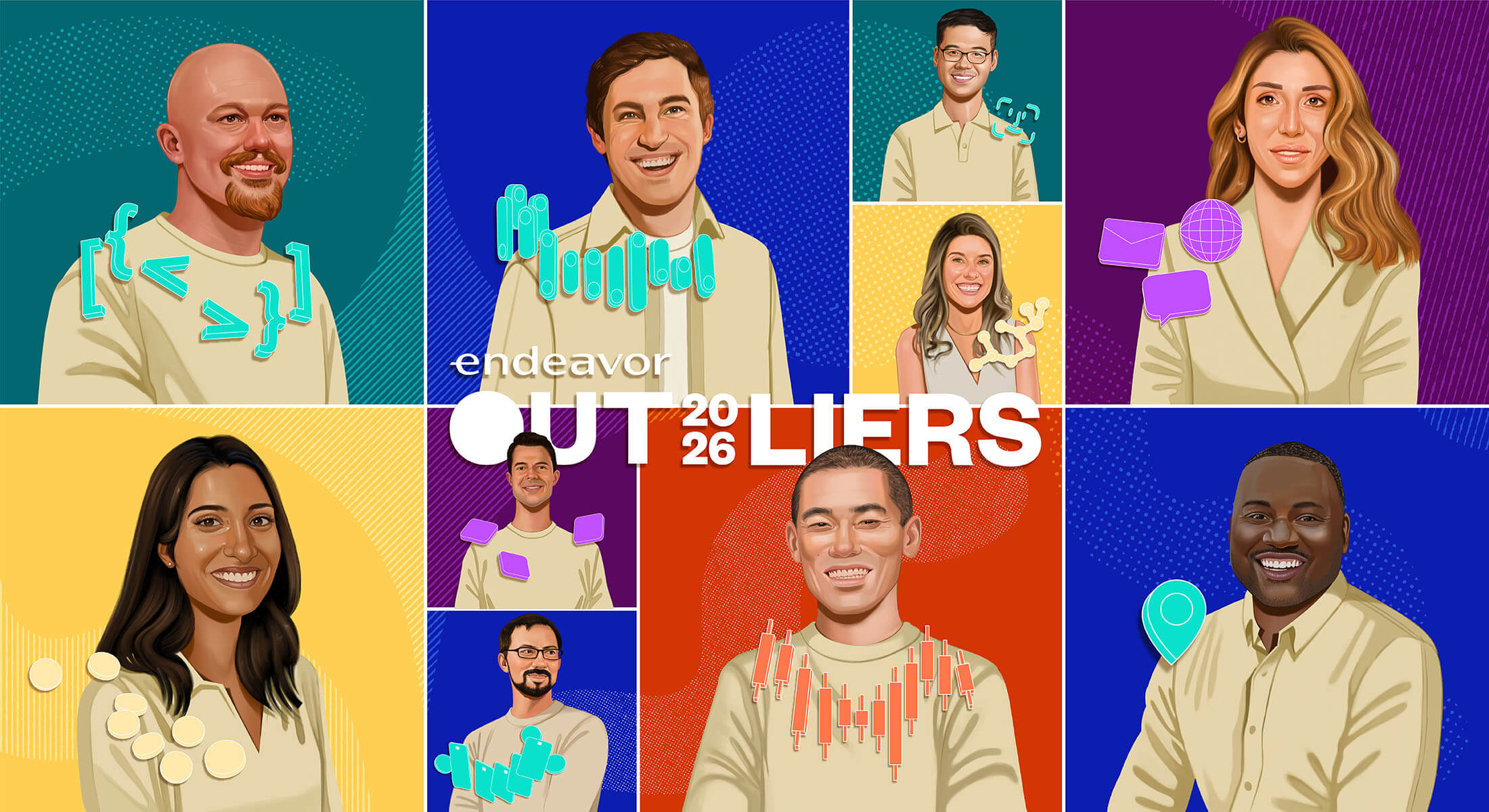
Discover the full class of companies building the future from Elsewhere. Meet the 2026 Endeavor Outliers class.
Featured Stories


Eight Outliers Changing Our Relationship With Food

Eight Application AI Outliers Building Beyond the AI Hype

Related Articles
Eight Outliers Changing Our Relationship With Food