The markets VC still can’t see
VC is a game of pattern breaking, not pattern matching.

Venture capital has a blind spot the size of the world. Emerging markets account for 61% of the global population and 38% of global GDP — yet attract only 8% of private-capital investment. In the first half of 2025, nearly two-thirds of all venture dollars still went to the US. The imbalance is stark. But for those who look Elsewhere, it’s also the edge.
When we talk about Elsewhere, we don’t mean a single geography. We mean markets whose share of venture investment is wildly disproportionate to their population size, economic growth, and entrepreneurial potential. They include the obvious rising powerhouses like Brazil and Nigeria, but also frontier hubs like Kenya, Vietnam, and Pakistan, and under-the-radar hubs like Kazakhstan or Ghana.
The Silicon Valley playbook offers one model. Elsewhere offers many — and with them, a thousand new ways to succeed. For those who claim to be contrarians: this is your moment. The biggest winners of the next decade are already being built far from the spotlight.
Here are three ways companies thrive Elsewhere while breaking from the Silicon Valley script:
|
1. Elsewhere, endurance is embedded |
|
It’s a tale as old as time: Investors rush into a new market when they first see potential, but when the early startups struggle or fail, they pull back. This period is known as the “trough of disillusionment.” From the outside, it looks like confirmation that the market isn’t ready. But the mistake is assuming those early failures mean the opportunity doesn’t exist. In reality, those first movers clear the path — they educate customers, build talent, and pressure incumbents. |
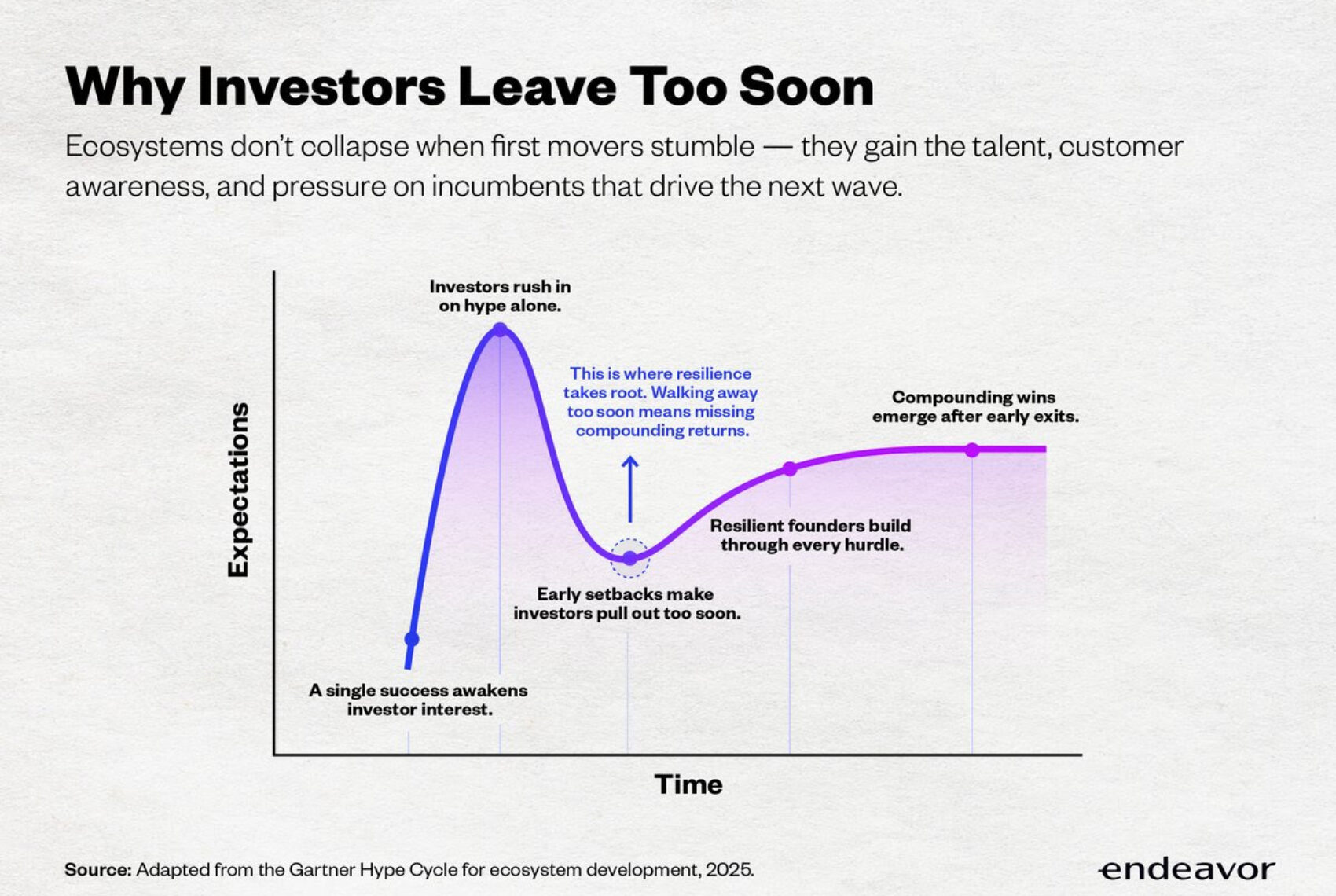
The next wave of companies often succeeds precisely because the first ones took the hits. By leaving too soon, investors miss the compounding effect of those initial attempts.
Our rule-based VC fund, Endeavor Catalyst, made its first investments in Türkiye in 2012, in Yemeksepeti, AirTies, and Peak Games. When Asli Kurul Türkmen, Managing Director of Endeavor Türkiye, was asked to summarize the key macro events that went wrong over the 10 years that followed, she answered: “Basically, everything short of a giant asteroid crashing down.”
Jokes aside, the country was mired with social and political unrest, economic turmoil, and even natural disasters. Despite some of our co-investors retreating from the country, we stayed the course and doubled down, making 11 additional investments over this time period.
Over a decade later, Türkiye is our top-performing market across all of our funds. And those three early investments?
- Yemeksepeti was acquired by DeliveryHero in May 2015 for ~$600M.
- AirTies was acquired by Providence Equity in April 2022 for an undisclosed amount.
- Peak Games was acquired by Zynga in June 2020 for $1.8B.
In spite of its challenges — or perhaps because of them — Türkiye is a thriving entrepreneurial ecosystem that has produced six companies valued at $1B or more.
Enduring founders build to withstand and even leverage cycles of instability, knowing that market conditions will change. The investors who stay alongside them and understand their non-linear paths emerge in the strongest position when the time comes to reap the rewards.
|
2. Elsewhere, timing red flags become local advantages |
|
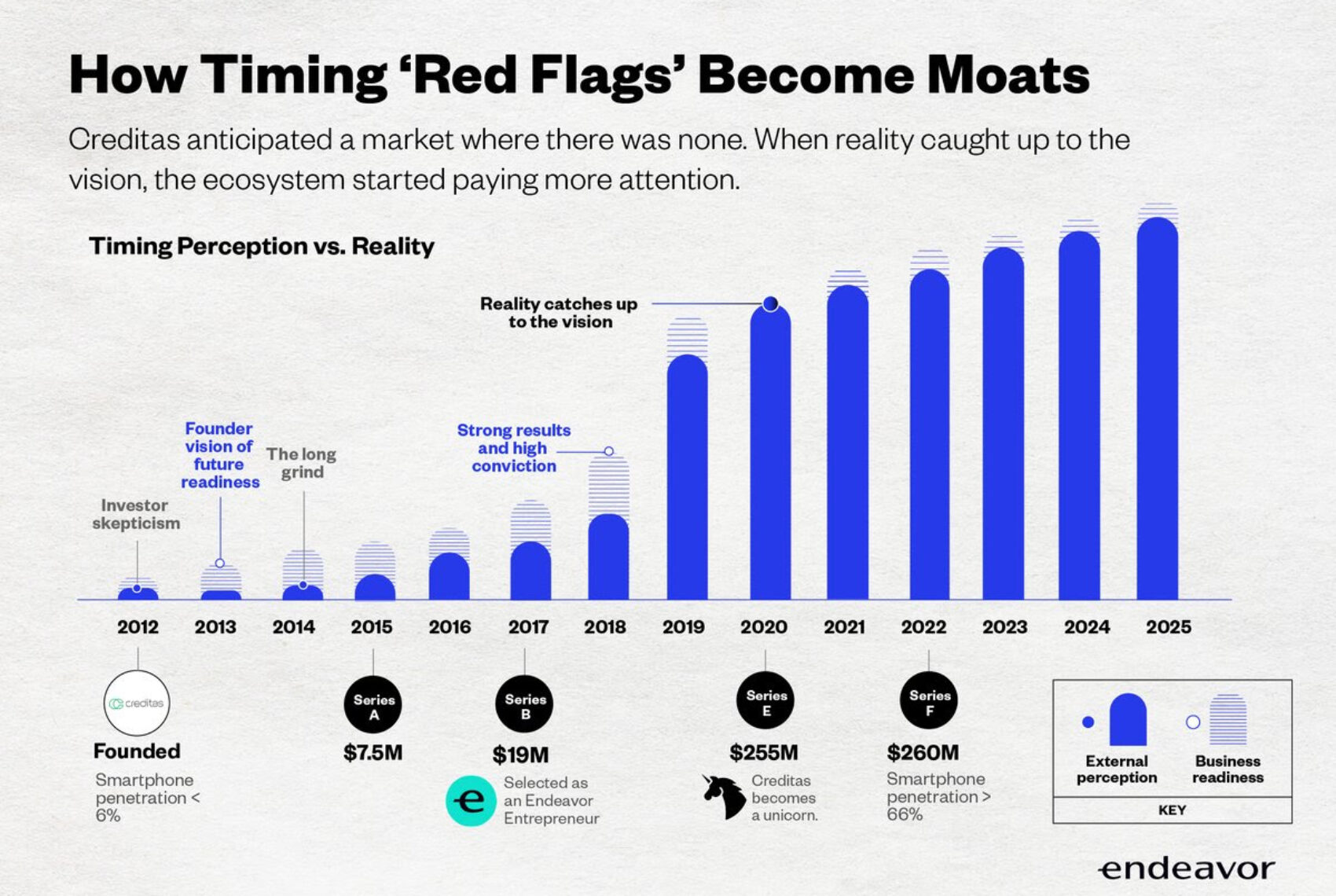
When Sergio Furio decided to move to Brazil in 2012, the country lacked not only a startup ecosystem, but also a market. Creditas was built as a platform to deliver the cheapest financing a person could get — but the middle class wasn’t even online then. In fact, smartphone penetration was less than 6%. “It was completely against the odds”, he said. No one wanted to invest in their seed round. “And it took me four years to get to our $7.5M Series A round”, Sergio noted. But between 2019 and 2021, the company raised almost $800M in total. They anticipated that smartphone penetration would reach 60-70% soon. And it did. They predicted that the incumbents’ profitability would keep them from pivoting. And it did. Eventually, reality caught up to the vision. Now making over $400M in revenue, Creditas proved that the biggest winners often look “wrong” at the start: they may emerge in markets considered too small or “not ready,” build products that don’t match dominant tech narratives, or adopt go-to-market strategies unfamiliar to global investors. |
An Iraqi super-app offers a similar — and more recent — example. At first glance, it may seem scrappy that its founder personally recruited drivers or that most users preferred to pay in cash. Yet those choices were exactly what accelerated the country’s digital transition and helped the company capture roughly 80% of its category.
That’s why Hande Cilingir, founder of Insider — a Turkish AI-powered omnichannel customer engagement platform with over $772M in funding — doesn’t believe in a one-size-fits-all expansion strategy. What has made the company successful in 29 countries has been a laser-focused local approach to each new market.
" People think we started Insider once, but we started it 29 times. "
Hande Cilingir
Endeavor Entrepreneur and co-founder of Insider
|
Elsewhere, many of the strongest companies emerge by betting on local timing and conditions long before they’re obvious to everyone else. That’s why “red flags” sometimes deserve a second look — they could be a moat instead. |
|
3. Elsewhere, value expands beyond one’s cap table |
|
A founder’s real footprint isn’t only in revenue or market share, but in the number of future founders, investors, and operators they influence. Investors should take a founder’s ability to mentor, invest in, and champion other entrepreneurs as seriously as they would their balance sheet. That’s because founders with a strong Multiplier Effect shape their market’s investability. They create more opportunities for others — and for themselves — over time. Though it may seem like a distraction to the untrained eye, the time they invest in building these networks comes back exponentially as future partners, customers, key talent, investors, and even acquisition deals. Insider’s 34+ alumni-led startups are evidence of this effect in Türkiye and beyond. LemFi, a Nigerian fintech, only exists because of the founder’s experience at Flutterwave, another Endeavor company now worth $3B as Africa’s most valuable startup. Careem, the UAE-based super-app acquired by Uber for $3.1B, produced 124 companies by former employees and invested in 91. |
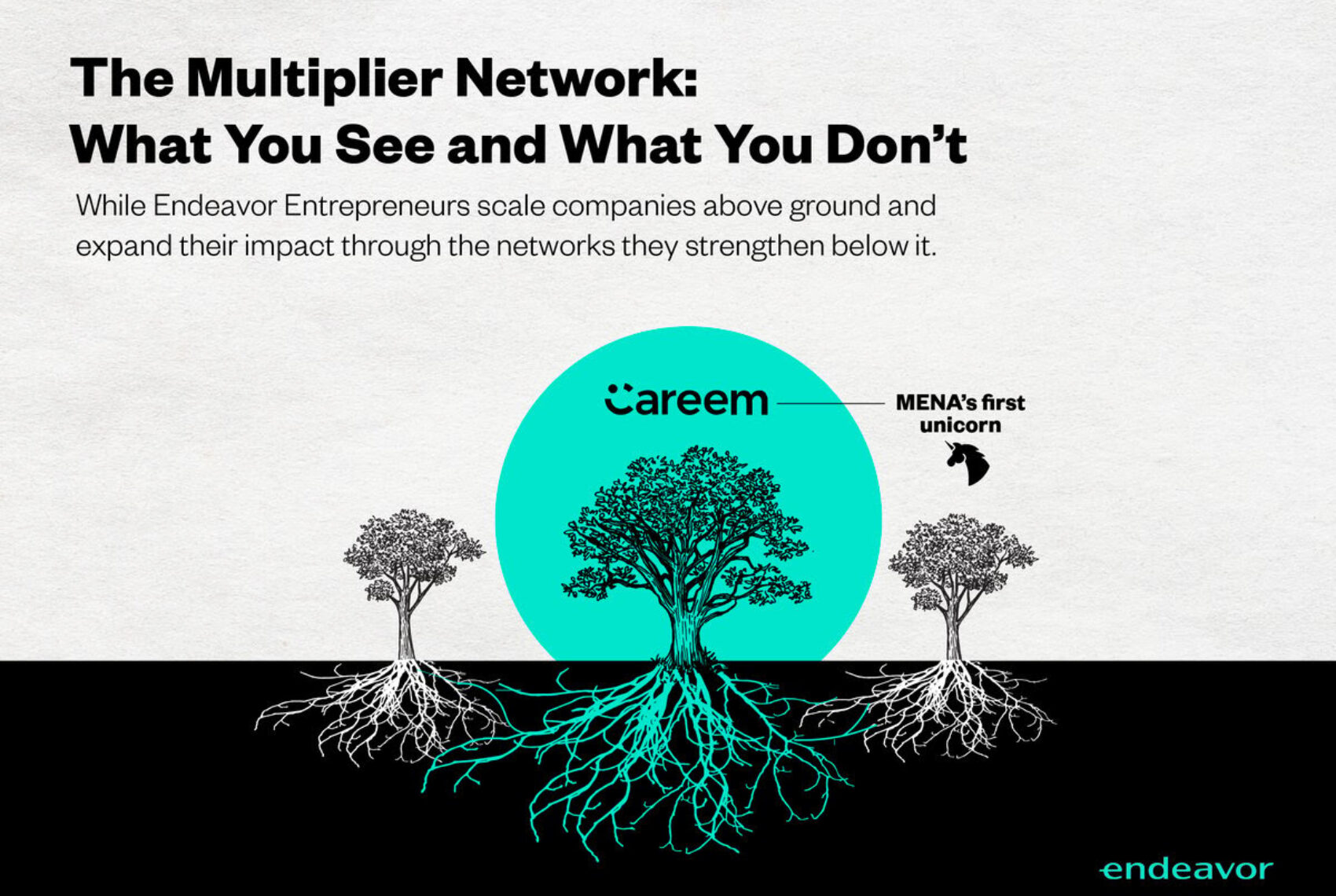
The strongest entrepreneurs from Elsewhere turn their ecosystem into fertile ground. Backing multipliers gives investors privileged early access to deals, accelerates the velocity of future gains, lowers the risk profile of the market, and builds resilience around the portfolio.
Investing in multipliers now seeds the next decade of unicorns. Waiting until ecosystems are “mature” means paying maturity prices. And returns compound when you invest in people with gravitational pull across their communities.
When Greece was going through deep economic turmoil, our Co-founder and CEO Linda Rottenberg got a call from Greek business leaders: people leaving the country was only making the crisis worse, and they thought Endeavor could help. In 2012, we opened our first European office in Athens.
“Why, in God’s name, if you were going to start doing business in Europe, would you start by doing business in Greece?”, a reporter asked Linda at the time.
The answer was simple: when economies turn down, entrepreneurs turn up. To date, Endeavor Greece’s 33 companies have raised over $1.7B and are valued at around $8B as Greece recovered and became one of Europe’s fastest-growing economies. We expanded to 30 other markets since then — including places that others wouldn’t, such as Ukraine in 2024 in the middle of war.
Elsewhere isn’t waiting to be discovered. It is being built in real time, by founders who see precious possibilities where others only see risk, inefficiency, or delay.
Their business models and value creation can look unfamiliar to global investors — until they don’t. That unfamiliarity is where the outsized opportunity lies.
Featured Stories
From the Milky Way to rural Peru – tracking the movements of space’s startup stars





Related Articles