The Race for the Next AI Success Story Is Not Where You Think
In 2024, 80% of venture capital investment dollars for AI went to the US and China. Looking beyond the infrastructure layer to the applications that will provide the next great AI success stories, we’re betting big on Elsewhere regions — here's why.

It’s easy to call the AI race won and done. The victors are the same big names and locales we’re all used to – your OpenAIs, your DeepSeeks, your Anthropics. In 2024, 80% of the $252B invested in AI went to the US and China.
But any investor tempted to sit back on their laurels will miss the biggest opportunities in AI, a global race which is already quietly underway.
From Bengaluru to Warsaw, Istanbul to Milan, companies in regions Elsewhere are levelling up, preparing to launch the next – and largest wave of AI innovation yet.
This is a global shift we’ve seen before. In 2005, 90% of all venture dollars went to US companies. Twenty years later, the scales have finally tipped, with 60% of venture dollars going to international companies. Similarly, the infrastructure layer of AI – OpenAI and its kin – is already heavily commoditized, just as we saw when Amazon Web Services (AWS) opened the gates to the cloud-computing era.
But AWS didn’t capitalize half as well as the companies that built applications upon its infrastructure – companies like Shopify, Snowflake, and Zoom. According to Summit Partners, in software, the cloud application layer is now three times more valuable than the infrastructure.
“The greatest opportunity in AI lies not in building the models, but in applying them to problems people care about,” said Sarah Wang, General Partner at Andreessen Horowitz (a16z). It’s in this application layer that countries outside typical venture-capital hubs – the places we call Elsewhere at Endeavor – are set to take off. Venture capitalists who fail to pay attention to these opportunities may well miss the boat.
Poised for success
Global companies aren’t building models. They’re building products that users choose. And they’re scaling fast without fanfare or funding from the usual suspects – as we can see when we look at just a few companies headed by Endeavor Entrepreneurs.
Try turning to Türkiye, where Codeway is building AI-powered mobile apps, three of which appear in a16z’s top 50 AI apps. Codeway, with zero venture-capital investment, is already profitable and scaling fast, turning over $100M+ in revenue.
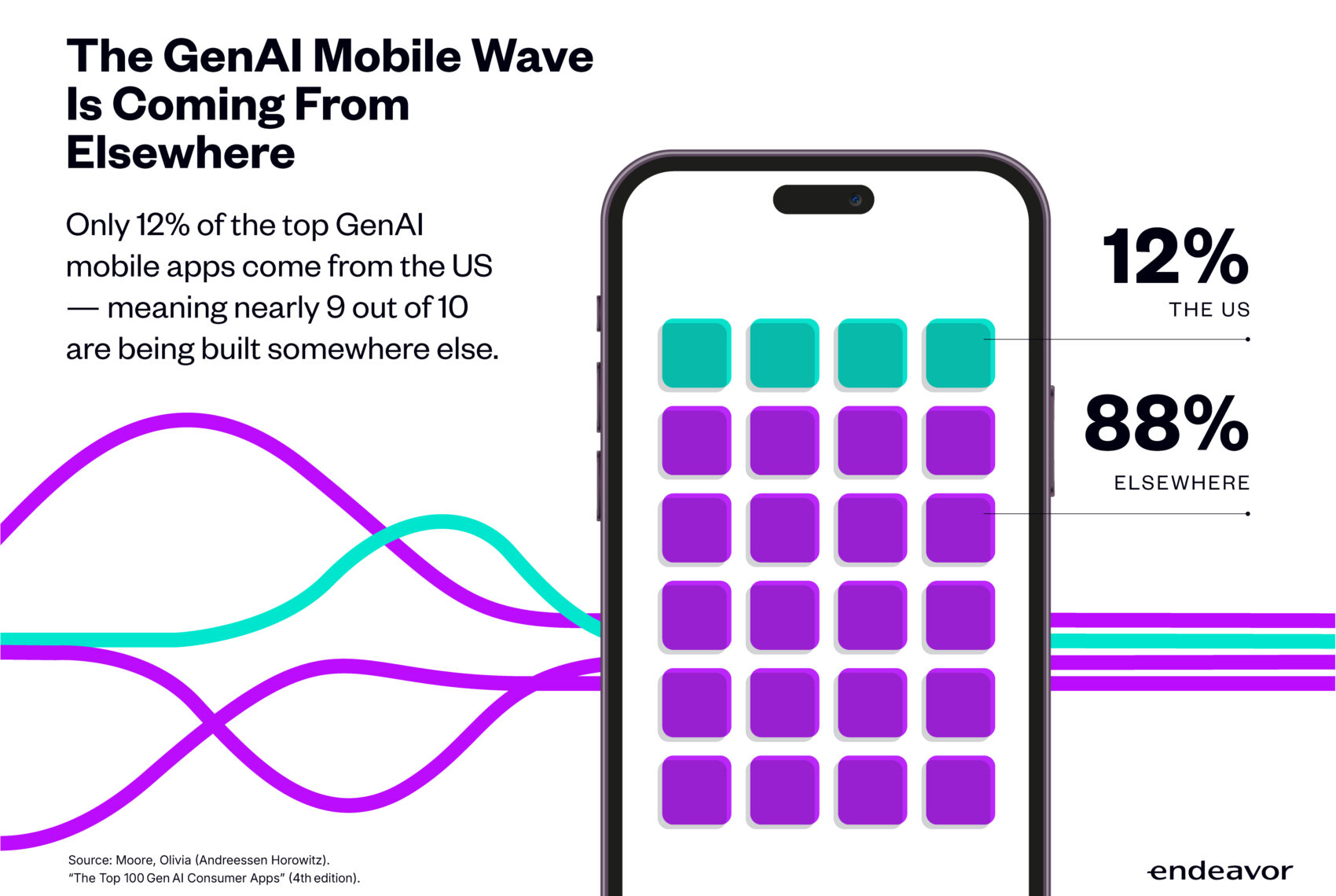
Bending Spoons – the little-spoken-of Italian holding company that now owns well-known apps like Evernote, Remini, Splice, and more – has begun to use AI as a merger and acquisition tool, power-boosting their already powerful eye for companies with the potential to take off. In Spain, Submer is building sustainable and data centers, offering a solution for one of AI’s most frequent critiques. From Tunisia, AI startup InstaDeep was recently acquired by German pharmaceutical company BioNTech for $682M. In Vietnam, AI-powered learning app Elsa is teaching English to 50 million users worldwide.
At the 2025 Endeavor Catalyst Investor Meeting, Managing Director of International at OpenAI Oliver Jay was asked to bet on which city outside of the US, China and UK would be a hub for AI in five years: he chose Bangalore. “Talent is abundant and the population is young,” Oliver said. “When you go to India now, AI is in the water.” India is also number one in the world when it comes to AI skill penetration.

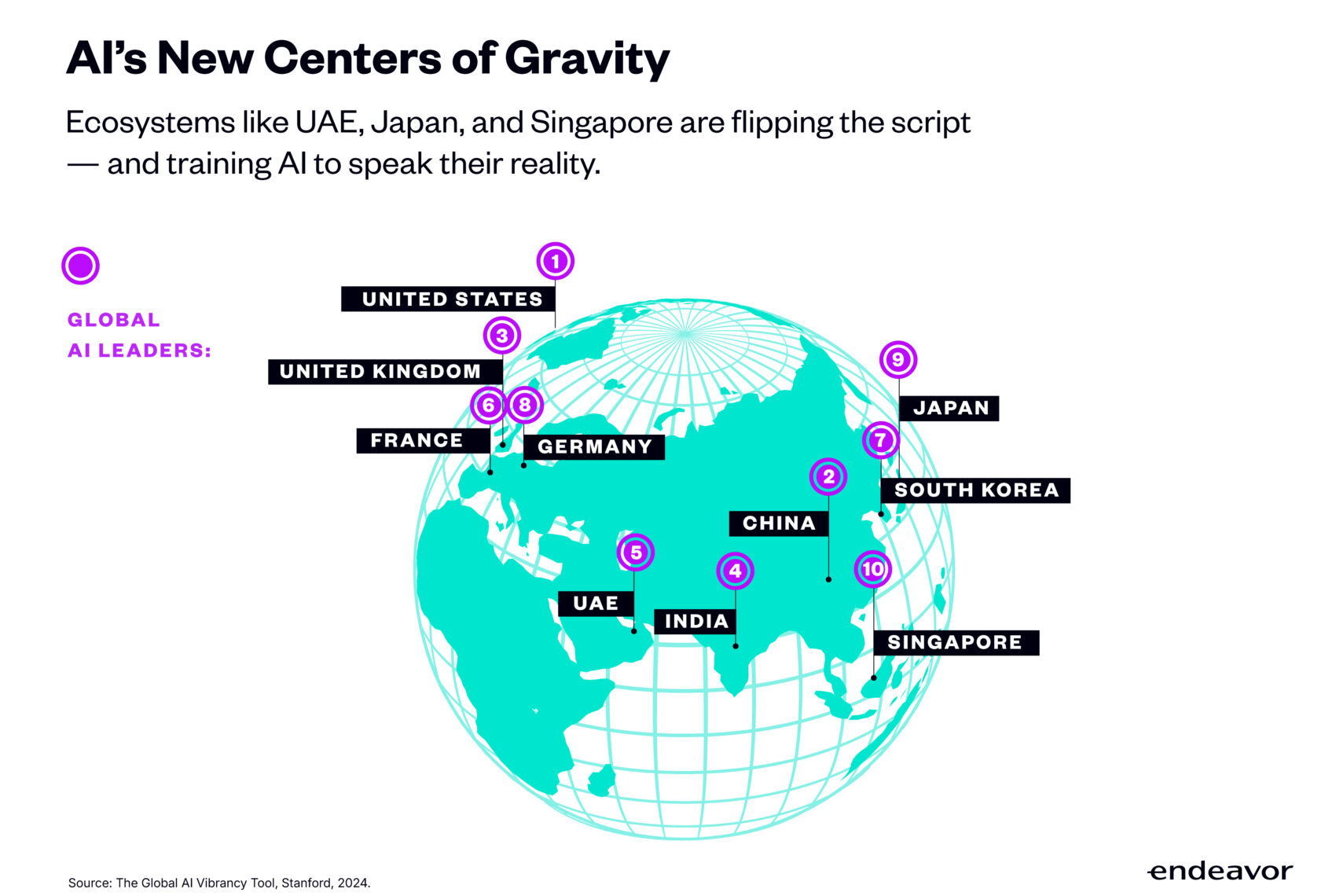
When Stanford studied the top AI markets globally, looking at talent, infrastructure, investment, education and more, the typical top players appeared. But there were some interesting turnarounds: the United Arab Emirates is in the top 10. Japan, Singapore, and Spain are listed above Nordic countries, historically more significant for the venture market. The playing field is wide open.
But Oliver highlighted the fact that the question of hubs itself is evolving. “In the past, what’s been hard about scaling companies outside of Silicon Valley has been talent, especially technical talent,” he said. “You can get your first five, ten, maybe twenty engineers, and then you tap out. Even if you have your engineers, it’s hard to find managers and leaders who have seen scale before. My hypothesis is that — and you’ll see this very soon, maybe tomorrow — technical talent should no longer be a barrier for scale. Amazing companies can be built from anywhere and scaled from anywhere. There will be many AI hubs.”
Don’t follow a false finish line
There are enough AI success stories from Elsewhere — like ElevenLabs, used by over two million developers and now valued at $3.3B — that it’s tempting for investors to believe that they’ve already caught the exceptions to the rule, and the rest of AI’s victories will follow traditional pathways. But as the story of venture capital itself shows us, those traditional pathways have a habit of evolving. And the inherently democratizing nature of AI makes it especially maneuverable for Elsewhere success, soon.

“Eighty percent of dollars [invested in AI] are flowing to the US and China, but 60% of AI developers are outside those markets,” said Pete Benedetto, Endeavor Catalyst’s Regional Lead of Europe at the Endeavor Catalyst Investor Meeting.
“Seventy percent of the downloads in the top 100 consumer [AI] apps are outside the US. So the developers are global, the users are global, and I believe the winners will be, too.”
The AI race when it comes to the application layer is just getting started, and it requires genuine and deep attention to Elsewhere regions. If you’re an investor waiting for the next OpenAI, you’ll miss the next ElevenLabs. Don’t stand around at the wrong finish line — you might find you’ve missed the starting gun.
Featured Stories
Silicon Valley got crowded again. Here are 400 reasons why we’re staying Elsewhere.

2025 Endeavor Catalyst Annual Report: A Look into Global Venture Capital

‘I don’t want to talk to any of you’: Addressing the VC Blindspot

AI isn’t confined by geography; capital is. Let’s shift the map.

Related Articles
Silicon Valley got crowded again. Here are 400 reasons why we’re staying Elsewhere.
2025 Endeavor Catalyst Annual Report: A Look into Global Venture Capital