Greek Prime Minister Kyriakos Mitsotakis, DeepMind’s Demis Hassabis and Endeavor CEO Linda Rottenberg on AI vs Humanity
At the Athens Innovation Summit, three leading voices in entrepreneurship and governance came together to talk AI. They ended up talking about humanity.

In Ancient Greece, Socrates taught his method to some of the brightest and best minds of his time: asking questions that stimulate discussion and critical thinking. He set up a legacy that has extended through history, practiced all the way from Plato to Alexander the Great to the great universities of our own time.
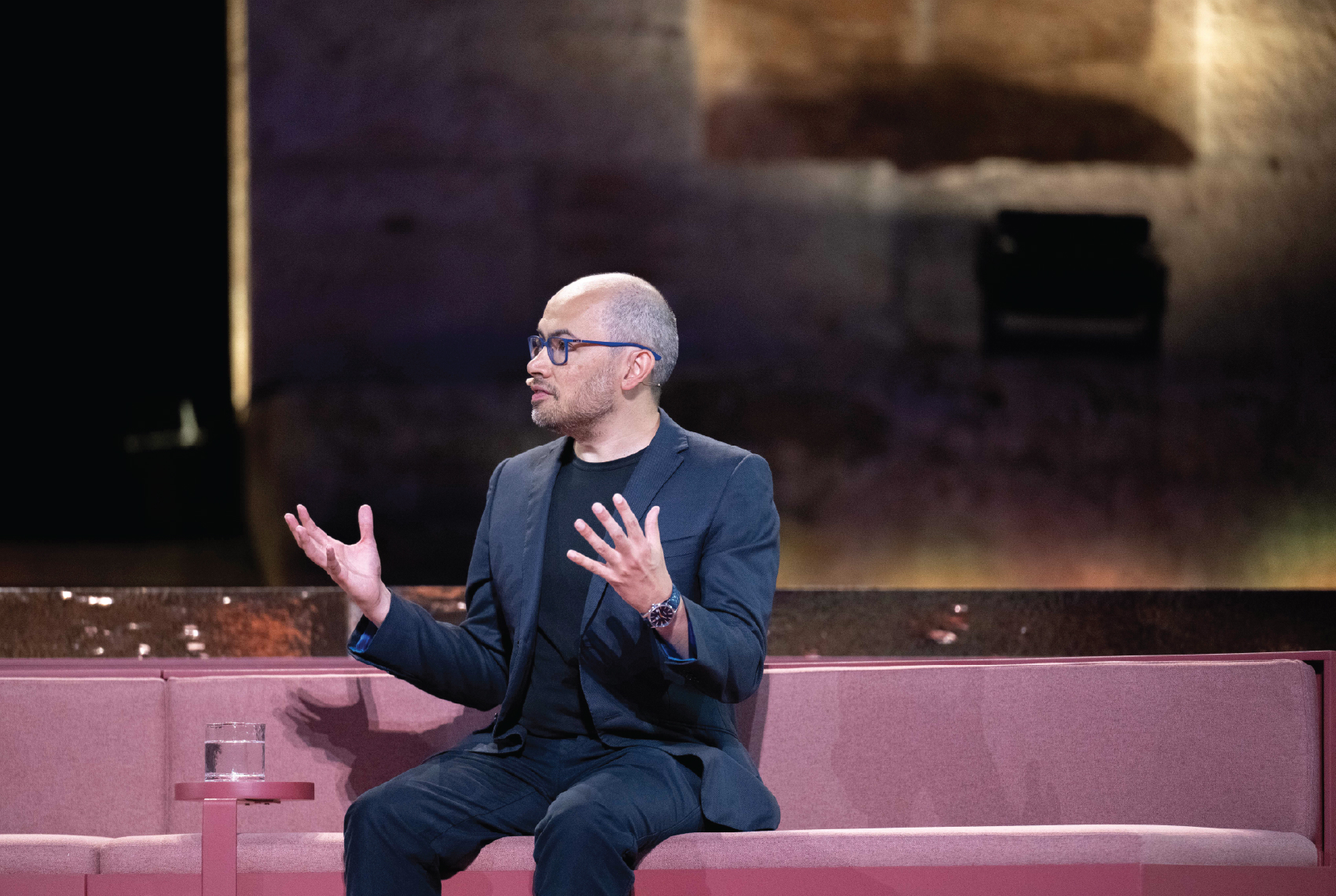
On an early September evening, Sir Demis Hassabis — co-founder and CEO of Google DeepMind — sat high above modern Athens, where orators once spoke and philosophers once reasoned, and nodded to the possibility of a personal Socrates for every student. Via AI, of course.
But for that to work, Hassabis said, we need to go back to our roots, and question everything.
This was the right place to pursue those questions — beneath the stones of the Odeon of Herodes Atticus. At the Athens Innovation Summit, Hassabis was joined by Linda Rottenberg, our CEO and co-founder, who works with hundreds of high-growth founders at the forefront of AI across the world and Kyriakos Mitsotakis, the Prime Minister of Greece.
“We are seated at the southwest slope of the Acropolis,” Linda said, “the birthplace of democracy, philosophy, and drama, to discuss one of the most dramatic moments in human history: The rise of artificial intelligence and the challenge it poses to all of us to get this moment right.”
Here are a few of the most interesting questions they explored.

If AI impacts the whole world, how can we ensure it reflects the whole world?
AI “is going to affect every corner of the world, every industry, all parts of society,” Hassabis said. “So I think it’s important for the world to have a say in how this technology is developed, not just a small part of California.”
We’ve already seen what happens when this goes wrong. The last epoch of the social media tech boom has been dominated by companies like Meta and ByteDance, built in the US and China. They control the market, including business models, regulations, and cultural narratives. They also have outsized impact and authority over our very identities: how we interact with one another, where we spend our attention, and even what we believe to be true.
AI’s impact will be far greater, and leaving its development to a few players would guarantee that it fails to reflect the diversity of human experience.
What’s needed instead are flourishing AI ecosystems rooted in local realities — where technology is built from local data, designed for local users, and informed by local values.
“As we see in the 50 countries where Endeavor operates, innovation is everywhere,” Linda shared. “We’re big proponents of what we call the power of Elsewhere.” And if you need examples, look no further than Endeavor Catalyst’s portfolio: the number of AI-native companies, all from emerging markets, has tripled since 2017.
For that to continue, we need more risk-tolerant capital in emerging markets. We need local enterprises to adopt AI faster and create real demand. And we need to create environments where talent can be developed and see a future in their own markets. The promise of AI is not global uniformity but global participation — good news is we can do it all from home.
What happens to critical thinking and human potential when everything is just a prompt away?
“Our brain is a product of millions of years of evolution. But if it starts losing the capacity to do things, which it has been doing for many, many years, what could that mean for a generation of kids who may have difficulties just writing, if artificial intelligence can write for them?” Mitsotakis asked.
AI’s impact in education is already huge and worrying: from a cheating epidemic in US colleges to Colombian students failing exams, from blind trust to false confidence, we need to reckon with new challenges for AI to, as Linda put it, “make us superhuman, and not its pets.”
On that, all speakers agree — AI should not be a replacement for human activity or human thinking, but rather what it was created to be: an instrument.
“In the end, we’re a tool-making species,” said Hassabis.
With that, comes another question: what are the skills that make us truly human that we need to protect at all costs? Creativity, emotions, dreaming, and our core values may even cause us to see certain expertises under different lenses. For example, Hassabis said, “we may end up valuing nursing or caregiving more than being a doctor because of the different ways AI will affect those different professions. But perhaps we are undervaluing and underpaying caregiving today.”
Hassabis also stressed the importance of “the meta skills of learning to learn,” particularly important as the process becomes more autonomous and perhaps AI-assisted. “How do you learn about yourself? What conditions do you learn best under? How do you optimize your own learning rate on a new subject? Because one thing we know for sure is you’re going to have to continually learn I think throughout your career.”
In spite of the concerns, his outlook remains optimistic:
“If we build it in the right way, I think we can have this amazing new golden era of maximum human flourishing where we understand the universe around us a lot better.”

Whose responsibility is it?
We may be underestimating how transformative Artificial General Intelligence (AGI), an umbrella term for AI with human-like cognition; will be. Hassabis expects “the advent of AGI to be something like 10 times the impact of the industrial revolution, but maybe 10 times faster as well — so kind of 100x, a decade instead of a century”.
If that’s true, the question of responsibility becomes urgent. Mitsotakis pointed to his two main areas of concern, which are the mental health of kids and teenagers and AI’s “challenge to the democratic discourse and to actually getting to the truth of anything.” Another recurring topic, however, is its socioeconomic repercussions.
AI can create tremendous wealth, after all. “Now the question becomes: how is this wealth going to be split?” he queried. “Unless people actually see personal benefits from this revolution, they will tend to become very skeptical. And if they see — sorry for being so blunt — obscene wealth being created within very few companies, this is a recipe for significant social unrest.”
Disparity also tends to grow larger as the workforce is reconfigured. The most common narrative may be that people won’t be replaced if they understand how to leverage AI, but that’s not always the case. Mitsotakis recognized the hard truth: “AI enhances productivity, but it will also replace human labor, and every corporation will have an incentive to do that.”
Sentiments will vary on either side of the table for most topics, so for Hassabis, it’s important that all parts of society participate in the debate — especially while we don’t have the right types of institutions to deal with the complexity in these questions.
“Maybe we need to do some institutional building first over the next decade,” he added, “and then we can deal with the next era.” And while governance and regulatory frameworks have started to be implemented especially in Europe, “at some point, some sort of global arrangement will be necessary,” Mitsotakis added.
This requires collaboration on a grand scale. The educational sector, governments, businesses, and many more institutions need to work together to create a way for us to ride the wave of AI, rather than be ridden. And with more caution than ever before.

“The tech industry is famous for its ‘move fast and break things’ philosophy... I actually don’t subscribe to that view with this technology,” Hassabis said.
“We have to be more thoughtful about it. We’ve got to get that balance right of being bold with the opportunities, but being responsible about mitigating the risks.”, he added.
The ruins of an old civilization, the birth of something new
According to Greek mythology, long before humans had cities or wrote code, they lived in darkness: cold, vulnerable, afraid. It was Prometheus who snuck up to Mount Olympus and stole fire from the gods to bring it back to Earth. Hope and progress were born.
We, too, stand at the edge of something transformative. But much like fire, AI holds the ability to destroy as well as create. Just as Prometheus believed people could wield fire with purpose, we need to reaffirm our identity as a tool-making species and keep our grip over AI by asking those difficult questions.
“Look what humanity’s created with our minds,” Hassabis said, drawing attention once more to the inspiring Athenian setting. “Modern civilization, modern science, modern philosophy. I think we’re infinitely adaptable and I think we’ll do that again for this next era.”
Featured Stories
From the Milky Way to rural Peru – tracking the movements of space’s startup stars



Related Articles