This website is embargoed until March 14, 2024.
All content is only to be viewed by official partners and is not to be shared
Dubai’s Ecosystem Strengths
An Analysis of Founder-Focused Growth
By Endeavor Insight
This website is embargoed until March 14, 2024.
All content is only to be viewed by official partners and is not to be shared
By Endeavor Insight





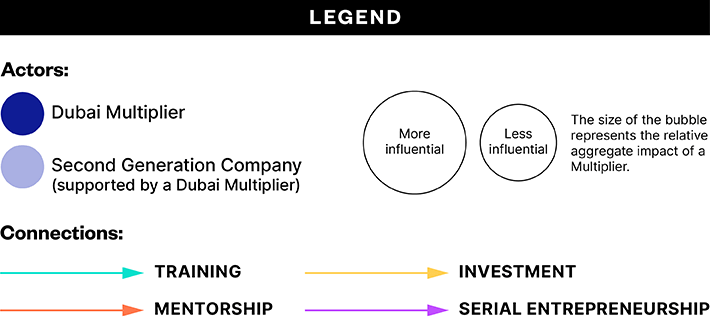
Dubai’s entrepreneurial ecosystem is powered by bold founders building transformative companies and then multiplying their success. High-growth entrepreneurs in the ecosystem are training former employees who go on to launch their own ventures, mentoring rising founders, and backing the next generation through angel and institutional investment. By doing so, these Multipliers create ripple effects that extend beyond their own companies. This is the Endeavor Multiplier Effect™ in action.
Multiplier /mul·ti·pli·er /noun — A successful founder with the ability to impact the success of other founders.
The Endeavor Multiplier Effect™ /noun — The collective impact that successful founders have when they reinvest their success in other promising founders.








Baklava Made Better (BMB) Group is a food manufacturer that grew from making traditional confectionery to exporting healthy snacks to over 30 countries. 6
Founded by cousins Mohamad Khachab, Mohamad, and Bilal Ballout, the company operates a vertically integrated business supplying over 30 countries with high-quality, locally made, and healthier alternatives to imported brands. Its rapid expansion redefined “Made in Dubai” for the health-conscious market and made BMB one of the region’s fastest-growing food manufacturers. In 2018, Mohamad Ballout launched Kitopi, a foodtech unicorn that operates a cloud kitchen platform.7 In 2021, Agthia Group acquired BMB in one of the Gulf’s largest food and beverage exits.8 Since then, the founders have gone on to start new ventures, invest in and mentor the next wave of entrepreneurs. From a family kitchen in Dubai to shelves across the world, BMB shows how regional businesses can scale globally and turn success into a platform for others to grow.
Careem started as a ride-hailing app and grew into one of the region’s leading tech companies. Uber’s $3.1 billion acquisition of Careem in 2019 unlocked a wave of entrepreneurial activity. Former employees making up the “Careem Mafia” are launching new businesses across e-commerce, mobility, fintech, and logistics. The founders continue to fuel the local market as mentors and investors in numerous ventures across the region, and globally. In 2023, Careem spun out its Super App, from its core ride-hailing business, integrating everyday services such as transportation, food and grocery delivery, and digital payments across the Middle East, Africa, and South Asia in partnership with e&.
Checkout is a global payments platform built in Dubai. It offers end-to-end processing solutions to merchants in over 150 countries.
Founder and CEO Guillaume Pousaz recognized that legacy systems weren’t meeting the needs of fast-scaling online businesses, and built a payments platform designed for performance and scale. More than a decade later, Checkout has scaled into a global decacorn, processing billions of transactions annually for companies shaping the digital economy, including eBay, DocuSign, Klarna, Netflix, Pinterest, and Sony. It helped position Dubai as a hub for financial infrastructure. Today, Pousaz continues to back and mentor entrepreneurs through his investment platform Zinal Growth, and as a global board member at Endeavor, where he supports emerging tech founders.
InstaShop is a mobile-first grocery delivery platform that introduced hyperlocal logistics to the region. It allowed users to order from nearby supermarkets, pharmacies, and specialty stores through a single app. Its early backing came in 2016 from Jabbar Internet Group, the venture firm launched by Maktoob’s founders, and Souq which allowed InstaShop to demonstrate how strategic capital and strong execution can convert local inefficiencies into scalable digital platforms. Four years later, Delivery Hero acquired the company for $360 million.
Founder John Tsioris has since reinvested in new businesses across health tech, mobility, fintech, and proptech. He mentors founders between the Middle East and Europe. InstaShop’s trajectory shows how founder exits can support subsequent company creation. Each link transferred capital, playbooks, and operational experience leading to a faster and more connected ecosystem.
Kitopi is a cloud kitchen platform that enables restaurant brands to scale without upfront investment. It manages the entire value chain, from procurement to delivery.
SoftBank made its first MENA investment when it led Kitopi’s $415 million Series C round. The deal valued Kitopi at unicorn status. It reflected confidence from global investors in the Middle East’s foodtech infrastructure. Co-founder Mohamad Ballout applied operational lessons from his earlier venture, BMB Group, while Bader Ataya brought consumer insight from Mumzworld, linking two of the region’s leading consumer businesses. The founders now actively mentor the next wave of foodtech entrepreneurs. Kitopi demonstrates how knowledge sharing between teams is supporting innovation across the Gulf’s consumer tech ecosystem.
Maktoob launched the first Arabic-language webmail service, enabling users across the Arab World to communicate online in their native script at a time when major platforms lacked Arabic support. In 2009, Yahoo! acquired Maktoob for $164 million. This marked the first major exit of a UAE-based tech company to a global player. The deal contributed to greater global investor interest in Dubai and the wider MENA venture ecosystem.
Soon after, founders Samih Toukan and Hussam Khoury launched Jabbar Internet Group, one of the region’s first venture firms, reinvesting in Souq, CashU, and InstaShop, while building key infrastructure for e-commerce, fintech, and gaming. Former Maktoob employees have since gone on to launch and lead ventures across digital media, gaming, edtech, e-commerce, and fintech. Maktoob helped train talent that went on to build new companies across the Arab world.
Launched in 2011 by Mona Ataya, and her brother Bader, Mumzworld introduced e-commerce for mother and baby products in the Middle East. At a time when online shopping faced skepticism, they built consumer trust, normalized digital payments, scaled supply chains, and expanded to over 20 countries.
Drawing on her Bayt experience, Mona grew Mumzworld into a multi-sided marketplace. She introduced returnships for mothers, led one of the region’s first all-women angel rounds, and raised six rounds of capital in a market where women received less than 1 percent of funding. She continues to mentor entrepreneurs and serve on private and public boards.
Bader went on to co-found Kitopi, now a leading Gulf foodtech venture. In 2021, Tamer Group acquired Mumzworld marking the Middle East’s first major woman-led e-commerce acquisition. From Bayt to Mumzworld, and Mumzworld to Kitopi, the Atayas illustrate how family-led entrepreneurship recycles talent, capital, and expertise across ventures in Dubai.
Namshi, one of the UAE’s first online fashion retailers, offers clothing, footwear, and accessories from 500+ international and regional brands. Soon after founding Namshi, serial entrepreneurs Muhammed Mekki and Louis Lebbos launched AstroLabs, a corporate services platform that has supported over 2,000 high-growth companies to set up and expand their operations throughout the Gulf. AstroLabs also partners with regional governments and private sector players to design and run programs that develop strategic industries such as the technology, media, and industrial sectors.
In 2017, Emaar Malls acquired Namshi for $151 million, later selling it to Noon in 2022 for $335.2 million. Emaar’s acquisition integrated Namshi into the region’s entrepreneurial ecosystem, demonstrating that homegrown ventures could scale with local institutional backing. Hosam Arab went on to co-found Tabby, a leading buy-now-pay-later platform that has reached unicorn status and reshaped consumer credit across the Gulf.
Namshi’s alumni and capital went on to support the creation of new companies across the ecosystem. They illustrate how interconnected teams and repeat founders multiply impact, creating the infrastructure powering the Gulf’s next generation of ventures.
Property Finder was a first mover in digitizing real estate across MENA, shifting home search from print listings to online platforms. Operating in a market with limited listing verification and transparency, the company introduced quality scoring and verification systems to improve listing reliability. Its growth coincided with increased investor attention to proptech as a venture-backed category in the region.
Founder Michael Lahyani opened the door for global capital to flow into MENA’s proptech landscape. His founder-led share buyback from early backer BECO Capital returned capital to a leading regional VC, reinforcing LP confidence and releasing resources to fuel the newer wave of businesses. Today, Property Finder operates as a unicorn-valued company with a significant role in the regional proptech sector.
Souq was a third-party e-commerce marketplace that offered a broad selection of consumer goods online. Spun out of Maktoob, it offered electronics, beauty products, and automobiles tailored to markets across MENA.
As the Middle East’s first unicorn, Souq attracted over 45 million monthly users across 40 cities, proving that digital platforms could outpace brick-and-mortar retail. Beyond its online storefront, Souq developed logistics and payments capabilities through Q-Express and PayFort, building the infrastructure that linked MENA’s merchants to global supply chains.
Amazon’s 2017 acquisition of Souq.com, for a reported $580 million, established a new benchmark for regional scale and exit potential. It also accelerated investor interest in the UAE’s logistics, payments, and digital retail sector. Alumni have since launched new businesses in e-commerce, healthtech, logistics, and automotives.
Dubai’s long-term vision of a safe and open market for high-growth entrepreneurship rests on a combination of policy stability and agility. This approach encourages founders to not only stay and scale from the region, but to also reinvest their experience and capital in upcoming entrepreneurs. Within this context, Dubai Founders HQ serves as a central node, linking public and private ecosystem enablers through a hub-and-spoke model in support of the Emirate’s D33 economic agenda. It is designed to provide transparent, end-to-end support for founders at every stage of growth, from incubation to exit.
Dubai Founders HQ is a centralized hub built to connect founders with the resources, programs and opportunities they need to grow. A joint initiative by Dubai Department of Economy and Tourism (DET) and Dubai Chamber of Digital Economy, Dubai Founders HQ is the launchpad for ambitious entrepreneurs, designed to amplify Dubai’s startup ecosystem and contribute directly to the Dubai Economic Agenda, D33.
Dubai is positioned as a regional hub for founders looking to expand across MENA and internationally, and pursue strategic exits. Free zones such as the Dubai International Financial Centre (DIFC), Dubai Internet City and others offer investor-friendly structures with sector-specific regulatory frameworks aligned to global standards. Dubai Chambers improve market access for local companies through international roadshows, trade missions and flagship events.
Dubai consistently builds supportive conditions for entrepreneurship, ranking #1 globally in GEM’s National Entrepreneurship Context Index (NECI) for four consecutive years. GEM’s NECI is based on expert assessments of a country’s entrepreneurial ecosystem across 12 factors including finance, government policies and programs, education, R&D transfer, infrastructure access, internal market dynamics, and cultural or social support for entrepreneurship.
Through the establishment of the Dubai Future District Fund and the Dubai Chamber of Digital Economy, Dubai is expanding access to venture capital and accelerating investment activity. Major local companies have also drawn global investors such as SoftBank and General Atlantic to the city, giving emerging founders access to a broader base of foreign VCs.The UAE now leads MENA both in total funding and deal share signalling the strength of its capital landscape.
Dubai is advancing reforms such as 100 percent foreign ownership, free zones, and long-term visas, while simultaneously building a strong ecosystem for fintech and digital assets through The Virtual Assets Regulatory Authority (VARA), fintech licensing within DIFC, and regulatory sandboxes to help founders innovate and scale.
The impact of Dubai’s Multipliers has a global footprint. The Multipliers have supported more than 475 next-generation companies across 50 countries worldwide. These rising tech and tech-enabled companies span over 30 sectors, with almost 52 percent operating in priority sectors in the digital economy. Collectively, this newer wave of companies has raised $28.8 billion. More than half (53 percent) have secured over $10 million each in funding, and 11 companies (4 percent) have raised investment over $500 million each. Among this emerging group of companies are Dubai-based leaders such as proptech pioneer Huspy and eyewear retailer Eyewa, alongside global players like Spain’s AI-driven workforce platform Job&Talent and Turkey’s adtech unicorn Insider.
The Multipliers in Dubai tend to operate companies in sectors that boost the economy with high GDP-per-employee. When they reinvest in local founders of tech and tech-enabled businesses, they not only expand their impact on the UAE’s economy but also foster potential for homegrown unicorns.
The chart below shows how Multiplier support within MENA has increasingly been directed toward priority sectors driving the digital economy. The share of support for these digital economy sectors has doubled from 30 percent among companies founded between 2000 and 2007 to more than 60 percent in the 2021-2025 cohort, aligning Multiplier support with Dubai’s digital transformation goals.
UAE has set a target of increasing the digital economy from 2022’s 9.7 percent share of GDP to 19.4 percent by 2032. To support this effort, Multipliers can continue to strengthen Dubai’s role in digital transformation across the region.
A deeper analysis of Dubai’s Multiplier network reveals the importance of founder-to-founder connectivity. There are three strengths in particular that point to Multipliers as the foundation of future ecosystem progress, particularly in MENA.
When a new generation of founders receives support from Multipliers, they are better prepared to scale their companies. Previous Endeavor Insight research shows that these Multiplier Effects can help founders navigate challenges and take advantage of new opportunities, and it is associated with a higher likelihood of growth.
Dubai’s Multipliers provided support in two ways — directly, through mentorship and investment, and indirectly, through employees who gained training and experience at Multiplier companies and later founded their own ventures.
Direct forms of support are more frequently observed among next-generation companies that reach 50 or more employees. In the chart below, among companies that received investment, 52 percent had scaled to 50 or more employees, compared with 29 percent of firms with 1 to 49 employees. A similar pattern appears for mentorship — 31 percent of founders who received mentorship had scaled their companies, compared with 10 percent among smaller firms.
The pattern differs for indirect support through former employment. Among founders who were former employees of Multiplier companies, 22 percent had scaled their firms to 50 or more employees, while 62 percent had smaller businesses, as illustrated in the chart below.
NorthLadder is a UAE-based circular economy marketplace enabling consumers to sell their pre-owned electronics and upgrade to new devices through partnerships with leading OEMs, retailers, and telcos. The company was founded in 2021 by Sandeep Shetty (former Managing Director at Careem) and Mihin Shah, and subsequently secured institutional investment from Bayt’s Dany Farha through his VC fund BECO Capital. Headquartered in Dubai, NorthLadder has rapidly expanded into Europe with operations in Amsterdam and now employs more than 100 people. The company serves over 10 markets in the Middle East, Africa, and Europe. NorthLadder has built a tech platform for circularity and trade-in services in a global market estimated at over $150 billion. The company supports the UAE’s ambition to lead in climate technology and resource-efficient innovation, contributing to Dubai’s Green Economy for Sustainable Development strategy.
About half (53 percent) of the support from Dubai’s Multipliers is staying within the region. Specifically, the majority of training (64 percent) and half of investment (50 percent) is going to companies based in Dubai or MENA, while the majority of mentorship (58 percent) is going to companies outside the region, as indicated in the chart below.
While it is impressive that Dubai’s Multipliers are having a worldwide impact, the support that is reinvested within the region (especially more direct support like mentorship and investment) can bolster the local economy and regional growth for years to come.
Silkhaus is a leading proptech platform that empowers property owners in the GCC to transform their real estate into high-performing short-term rentals for leisure and business travelers. Founded in 2021 by Aahan Bhojani and later joined by Careem alumni Ankit Shah, Silkhaus is backed by notable early investors, including Mudassir Sheikha—Careem’s co-founder. Since launch, Silkhaus has grown to a team of more than 60 people and raised over $12 million in equity to accelerate expansion. The company reflects Dubai’s D33 vision by combining the city’s strong hospitality infrastructure with its digital capabilities to shape the future of short-term rentals.
Next Generation companies in MENA with founders who received support in only one way from a single Multiplier had an average headcount of 95 employees. Companies in MENA where founders received more support had 3.1 times as many employees, on average, as shown in the chart below.
Founded in 2020, Huspy provides infrastructure for real estate agents and mortgage brokers to build and grow their businesses. The company is present in 10 cities across 3 countries; UAE, Spain, and KSA. The company has received mentorship support from Kitopi‘s Mohamad Ballout, while also receiving investment from John Tsioris of Instashop. The company has raised $150m+ to date from global investors, including Sequoia, Balderton, Founders Fund, Fifth Wall, and others. Huspy is a proptech market leader in most of the cities it operates in and is generating billions in revenue per year.
Eyewa, founded in 2017, is the Middle East’s largest omni-channel eyewear retailer. Anass Boumediene and Mehdi Oudghiri, the entrepreneurs who started Eyewa were mentored by the founders of BMB Group, Checkout, and Kitopi; while also receiving investment from the founders behind Careem and Namshi. After receiving this support, the company has raised over $120 million to date, grown to over 1,000 employees and expanded to over 150 stores across the Gulf Cooperation Council (GCC).
Ones to Watch: The new wave of founders propelling Dubai’s growth.
Dubai’s Multipliers have played a crucial role in reinvesting capital, mentorship, and expertise into the region’s entrepreneurial landscape. To keep this virtuous cycle growing, the next generation of founders needs the same support and visibility. Bold entrepreneurs are pushing the boundaries of innovation and are seeding a new wave of high-potential companies atop Dubai’s world-class infrastructure. Below are some examples of these rising stars.




Founded in 2020, metabolic.health (also known as GluCare Health) is a UAE-based healthtech company that practises a novel ‘Hybrid Care’ model to improve the treatment of metabolic disease. The company was founded by Dr. Ihsan Almarzooqi, Ali Hashemi, and Zeina Abdalla. The company is a major contributor to clinical research regionally with over 50 peer-reviewed publications. They have established several partnerships including the first clinical partnership with ŌURA to integrate data from wearables, and large research partnerships with Eli Lilly, Roche, and Dexcom. The company is expanding its care model with new locations in Dubai and London. By creating new data-driven care pathways, metabolic/GluCare contributes to Dubai’s growing healthtech ecosystem.
CyberArrow was founded in Dubai in 2021 by siblings Amar and Ena Basic to develop automated and intuitive cybersecurity and regulatory compliance solutions for organizations.The platform keeps companies continuously aligned with international and national standards without heavy manual work or consultant dependency. CyberArrow has secured strategic cloud partnerships with G42 in the UAE and Mobily in Saudi Arabia, enabling secure regional deployments and trusted data residency. Before CyberArrow, the founders built and exited Keepeat, a SaaS company addressing operational inefficiencies.
Founded in 2022 by Emirati entrepreneur Amira Sajwani, PRYPCO is a UAE-based proptech platform simplifying real estate processes. In 2025, the company raised a pre-Series A round led by General Catalyst, the firm’s first proptech investment in the Middle East. PRYPCO brings real estate, fintech, and blockchain together to make the real estate market more transparent, tokenized, and accessible. Its work with the Dubai Land Department shows how entrepreneurial companies can help shape the city’s push toward digital assets and innovation. Amira Sajwani’s leadership reflects the rise of emerging Emirati founders driving Dubai’s proptech innovation.
Otera, formerly known as DeepOpinion, is an enterprise AI company that enables organizations to build AI-powered agents that automate complex tasks. The company was founded in 2019 by Stefan Engl, Steve Ramershoven, and the Emirati co-founder Ahmed Ghanim Al-Ali. The company now works with major clients such as the large German corporates Allianz and Siemens, as well as Dubai-based e&. Co-founder Ahmed Ghanim Al-Ali helps Otera bridge Europe’s deep tech ecosystem with UAE’s emerging AI policy, speeding up the country’s shift toward AI and automation.
This study builds on more than a decade of Endeavor research that has examined ecosystem growth around the world. What stands out about Dubai is its approach to entrepreneurship, which places founders at the center of its economic strategy. By combining supportive policy and robust founder-to-founder networks, Dubai has built a strong base for the next stage of its digital growth.
The following three strategies showcase the founder-focused approach that has resulted in the strong Multiplier Effects examined by Endeavor. These are the areas that Dubai can leverage into the future and that other markets can look to as exemplars of ecosystem strength.
Dubai has shown a long-term commitment to digital growth by creating dedicated hubs for entrepreneurial companies such as Dubai Internet City, Dubai Silicon Oasis, Dubai International Financial Centre. Reforms including 100 percent foreign ownership and long-term visas directly give founders the stability they need to scale. Institutions like the Dubai Future District Fund and the Dubai Chamber of Digital Economy link public investment with private capital to accelerate company growth. Dubai is also leading regional innovation in AI, fintech, and blockchain through initiatives such as the UAE’s AI Strategy 2031 and the Virtual Assets Regulatory Authority. As Dubai’s startup ecosystem has matured, the need for more structured founder engagement has become clearer. By centralizing founder engagement, Dubai Founders HQ reinforces the feedback loops that sustain Dubai’s founder-first growth model.
High-growth entrepreneurs are discovering the abundant opportunities opportunity in Dubai through industry tours. In October 2025, the Dubai Forward Industry Tour, an initiative organized by Dubai Founders HQ and Endeavor, attracted 25 founders and C-suite executives from around the world to learn about market expansion, industry dynamics, and exit pathways. Founders of top scaling ventures came from 17 countries including Indonesia, Singapore, South Africa, Brazil, Argentina, Spain, Ukraine, and the United States.
Through discussions with Dubai’s Multipliers, major corporates, and government agencies, they gained practical insight into regional expansion strategies and the city’s advantageous regulatory environment. The founders noted Dubai’s strong government support and the depth of the local talent pool as factors reflecting the region’s rising appeal for globally focused, innovative entrepreneurs.
“The industry tour in Dubai was an amazing opportunity to witness firsthand how the country is establishing itself as an entrepreneurial destination. It is becoming a hub for connection and that is attracting entrepreneurs from all over who see the city as an inspiring place to develop their business.” — Guibert Englebienne, Co-Founder of Globant (Argentina)
Through investment and mentorship, as well as training their employees, Multipliers are transferring critical experience and accelerating the next generation’s development.
Dubai’s ecosystem stands out in how it has fostered close connections among founders, as demonstrated by the strong relationships among the early Multipliers. As the entrepreneurship community grew, that support helped knowledge and success be reinvested back into the region.
Today, Dubai’s Multipliers are proven mentors for companies raising significant capital, navigating exits, and expanding globally. Up-and-coming founders reported that guidance from mentors from similar companies and regions provided them practical playbooks they could immediately operationalize. These experienced mentors also offered real-time guidance on specific business decisions such as structuring teams, defining profiles for important hires, and determining when to expand internationally.
The next generation of Dubai’s successful companies are becoming Multipliers, which creates a continued cycle that reinforces Dubai’s role as a center for founder-led growth. Going forward, there is a role for corporations, investors, and all ecosystem actors to foster these important dynamics among founders and enable more opportunities for founders to receive direct, tailored support.
Qlub illustrates how founders who receive support can set off a virtuous cycle of ecosystem growth by paying it forward. Founded in 2021 in Dubai by Eyad Alkassar and Mahmoud Fouz, Qlub is a QR-powered dining payment platform enabling diners to instantly view menus, place orders, and settle bills via smartphone. The company received investment from Namshi‘s Hosam Arab, and has since expanded to over 350 employees, expanding to Saudi Arabia, Singapore, Hong Kong, Brazil, and Australia. Qlub’s founders have also begun reinvesting in the ecosystem, with Eyad Alkassar and Mahmoud Fouz mentoring Martin Rohland, co-founder of Iraq’s super-app Baly. Qlub’s former employees are starting new firms across UAE, Saudi Arabia, India, Singapore, and Turkey.
“I am a strong believer in the multiplier effect. Watching other founders that have grown out of our ecosystem launch new startups, is almost as satisfying as watching customers use our own products. Just as we drew inspiration to become founders and learned a lot from others, we seek to continue this cycle and multiply our impact over generations of founders.” — Mahmoud Fouz, Co-Founder of Qlub
A new generation of founders is building companies with unicorn potential and accelerating the region’s digital transformation. Alaan, an AI-powered fintech platform, demonstrates how founder-led support and access to global capital continue to shape this next wave. Alaan helps businesses simplify their payments. It was backed early by Careem’s Mudassir Sheikha and went on to raise a $48 million Series A led by Peak XV Partners in 2025. Companies like this illustrate how Dubai’s strong infrastructure, combined with meaningful founder-to-founder support, is creating the conditions for the region’s next unicorns in sectors such as AI, fintech, and Web3.
“Dubai is a place that is attracting talent from several parts of the world given its friendly policies, supportive regulations and its strategic location between the West and the East. The region is becoming an attractive market for people building companies in fintech and consumer and with a few IPOs coming up, the potential of the region will finally be more visible to the world.” — GV Ravishankar, Managing Director of Peak XV Partners (formerly Sequoia Capital India & SEA)
For more information about this study, download the PDF report, which includes the detailed methodology.
We are the leading global community of, by, and for high-impact entrepreneurs — those who dream bigger, scale faster, and pay it forward. Driven by our belief that high-impact entrepreneurs transform economies, Endeavor has been on a mission to build thriving entrepreneurial ecosystems in emerging and underserved markets around the world since its creation in 1997.
Endeavor Insight is the research division of Endeavor that provides data-driven analysis and visualizations showing what makes entrepreneurial ecosystems thrive. Our research team of economists, data scientists, and policy analysts specializes in understanding the needs of high-impact entrepreneurs and evaluating the networks that enable them to scale up and pay it forward to the next generation of entrepreneurs. For more information, contact [email protected]
Endeavor’s UAE Hub is a launchpad for the most driven entrepreneurs scaling across borders. Positioned at the heart of a global crossroads, the Hub connects high-impact founders — especially those choosing UAE as a second home — with the networks, programs, and capital to grow beyond borders. It convenes Endeavor Entrepreneurs, Global Multipliers™, and top-tier investors through curated experiences at pivotal moments in their journey. With Endeavor Catalyst fueling cross-border investment, the UAE Hub is fast becoming a launchpad for unicorns, bridging global talent, capital, and opportunity — and powering the next generation of scale. For more information, contact [email protected].
The 2025 Endeavor Catalyst Annual Report is Out! See Where Global Venture Capital is Heading.