8 Global Venture Capital Trends to Watch in 2026
Stablecoins in Lagos. Robots in Bucharest. New pathways to liquidity in Riyadh. The next great wave of venture capital is rising Elsewhere.

At Endeavor Catalyst, we’re privileged to back more than 650 founders leading 385+ companies across 35+ markets. Around the world, a new generation of founders is building at the intersection of AI, fintech, and frontier markets, creating companies that look global from day one. Everyday, we see how venture capital’s next wave is unfolding far beyond traditional hubs, or as we call it, Elsewhere.
Looking back at last year’s trends, much came to pass. Secondary activity did, in fact, accelerate year-over-year as GPs and LPs sought liquidity. Bitcoin didn’t quite reach the $150,000 mark, but it did near $130,000, accompanied by significant activity across Elsewhere markets. Venture capital and innovation continued to thrive in the Middle East, and investors increasingly turned to Europe for AI deals — a trend reflected in the strong deals we executed there this year. (More on that shortly.)
With those results in mind, the Endeavor Catalyst team is looking ahead to 2026. The landscape continues to shift quickly, shaped by macro cycles, emerging technologies, and founder ambition in markets historically overlooked by venture capital. Against that backdrop, here are some trends we’re seeing as the next chapter of global entrepreneurship unfolds.
1. Stablecoins are thriving where currencies fail.
Not so long ago, during the first wave of crypto innovation amid the speculative trading of Bitcoin and other digital assets, we made our first crypto investments in exchanges like Mercado Bitcoin (Brazil) and Bitso (Mexico), and wallets such as Xapo (Argentina). We’d say that crypto’s speculative phase is now over.
You can see that with the adoption of stablecoins, a type of cryptocurrency backed by traditional assets such as the US dollar, which are quickly becoming the backbone of a new global financial system. The stablecoin market is now a $250B asset class that powers treasury, payments, and savings worldwide; transfer volumes surpassed Visa and Mastercard in 2024. With Circle’s $30B IPO and the Genius Act unlocking US regulatory clarity, both legacy institutions (like BlackRock and Fidelity) and tech disruptors (like Stripe and Robinhood) are racing to offer crypto-native financial products.
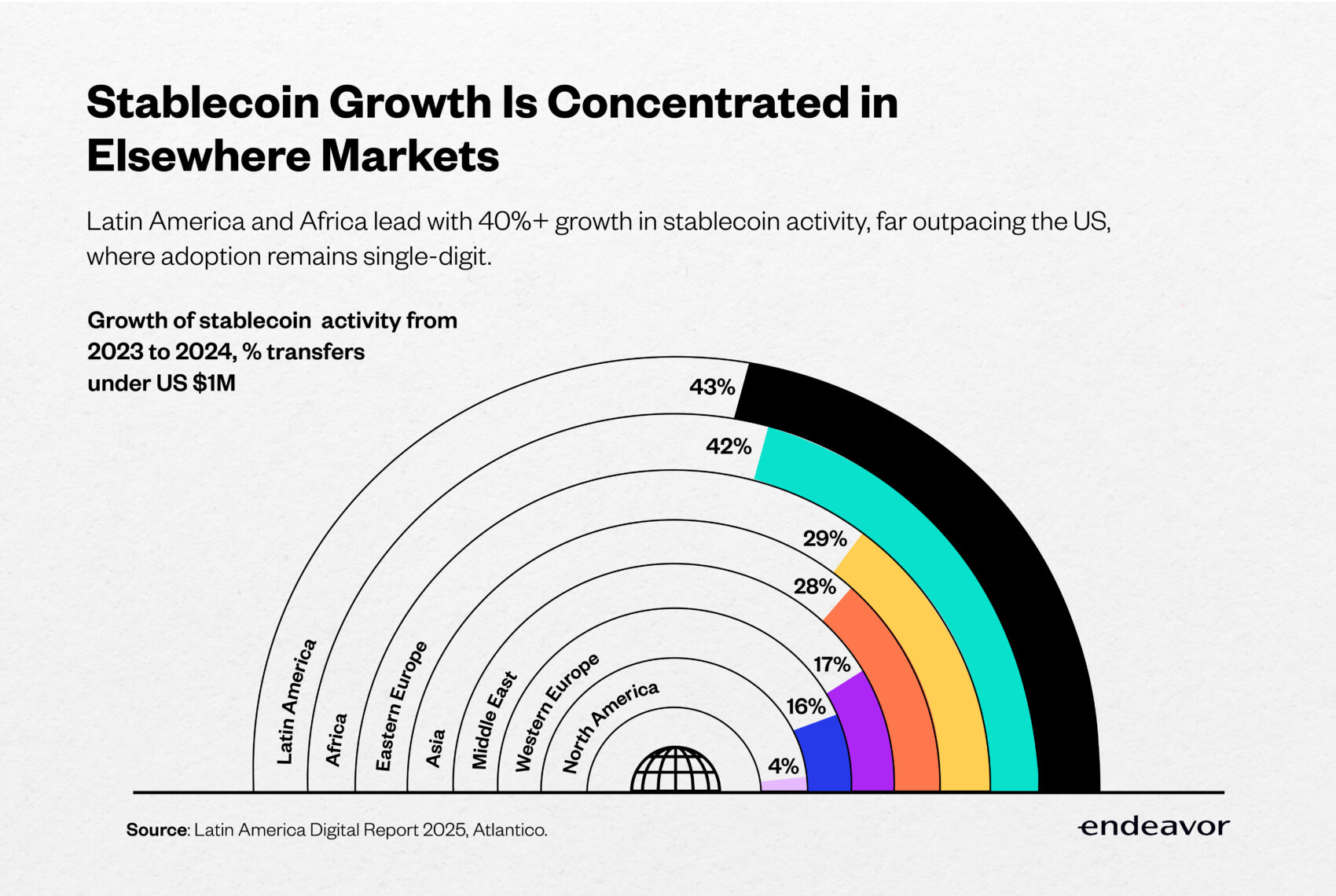
Emerging markets are driving global stablecoin adoption, fueled by inefficient financial systems and volatile currencies. In Latin America and Africa, stablecoin activity has grown 40% year-over-year, compared to just 4% in North America. In Argentina, where inflation reached 118% in 2024, stablecoins accounted for ~64% of all crypto trading volume that year. Similar trends are set to emerge in other markets like Egypt, Turkey, and Pakistan, where currency crises are accelerating the shift toward stablecoin adoption. According to Standard Chartered, as much as $1T could move from traditional banks to stablecoins across emerging markets.
Company Spotlight
Companies in our portfolio reflect this second wave of crypto, focused on real-world utility rather than speculation:
Looking ahead, crypto and traditional finance will continue to converge, with Elsewhere markets leading the way. Digital finance is no longer niche; it’s becoming the foundation of the global economy.
2. Drones and robotics are quietly reshaping the supply chain.
Fulfillment and delivery are no longer powered by human hands alone. Driven by the convergence of e-commerce growth, labor cost pressures, and breakthroughs in AI and robotics, automation is setting new norms in global logistics. In warehouses, machines are learning to see, move, and decide, and facilities leveraging robotics can experience up to a 50% increase in productivity.
At the same time, the sky is becoming the new highway, particularly when infrastructure challenges persist on the ground. In countries like Nigeria, where unreliable road networks make last-mile delivery difficult, Zipline, the world’s largest autonomous delivery system, is filling the gap. With more than 1.4 million deliveries completed — including 1.6 million vaccine doses to children in Nigeria in 2024 alone — Zipline is proving how innovation can leapfrog infrastructure limits and redefine access. While profitability might just be over the horizon, falling compute costs and AI-driven efficiency are accelerating global adoption. Walmart has completed 150,000+ drone deliveries since 2021 and is expanding across multiple states in the US; Amazon, having deployed its one-millionth robot, introduced generative AI to optimize robotic efficiency across its fulfillment centers.
Company Spotlight
Within Endeavor, we see companies leading the way in logistics automation.
- Dexory (Romania) builds robots that deliver real-time warehousing intelligence and detect operational inefficiencies;
- Matternet (Greece) just launched a drone-delivery pilot in Los Angeles and became the first authorized operator to deploy M2 Drone in KSA;
- Dronamics (Bulgaria), the world’s first cargo-drone airline, is slashing international same-day delivery costs by up to 50%.
The growing role of automation in the supply chain isn’t about humans versus machines — it’s humans empowered by robots and AI to orchestrate fulfillment and delivery that is faster, smarter, more resilient, and global in scale.
3. The path to liquidity is moving beyond IPOs.
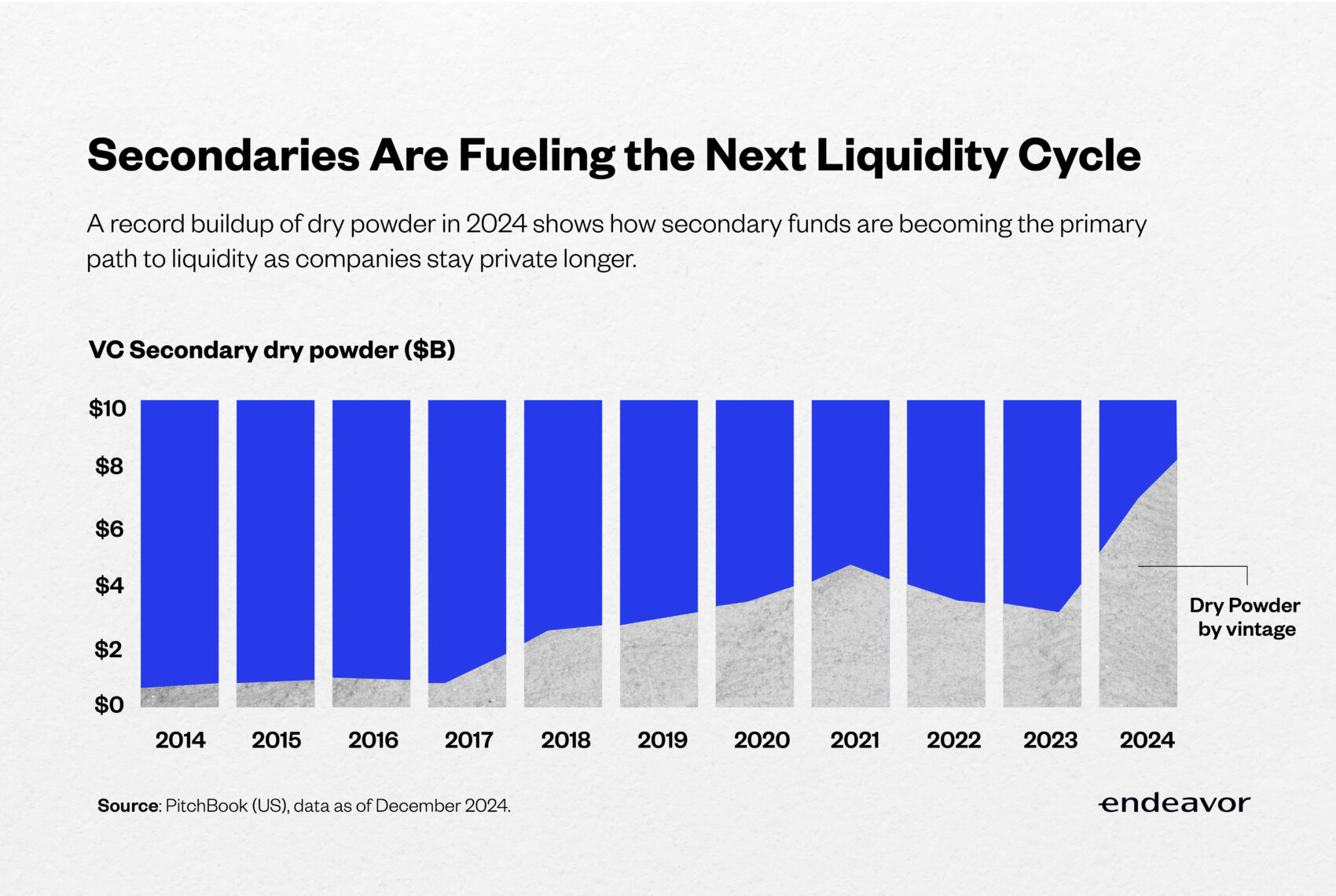
As companies stay private longer, secondary transactions — when shareholders sell their stakes to existing or new ones — are filling an essential liquidity gap.
The threshold for IPO readiness is higher than ever. The expectations for median annual recurring revenue (ARR) at IPO have increased from ~$80M in 2008 to roughly $250M today.
With venture funding alive and well in 2025, reaching its highest annual level since 2022, there is renewed momentum in the secondary market, driven by clearer price discovery and growing liquidity needs among early investors, founders, and employees alike. With the IPO window still largely closed and M&A activity subdued, secondaries have become a critical release valve for private market capital.
According to PitchBook, annual secondary transaction volume surpassed $60B in 2025, and early indicators suggest this is only the beginning. Secondary funds are sitting on billions of dry powder, accepting narrower discounts, and executing deals with greater speed and sophistication.
Company Spotlight
The rise of secondary transactions is evident in our own portfolio. In the past 12 months, we’ve had 10 liquidity events (as of December 2025), six of which have been secondary transactions. Two highlights:
- Tabby (UAE / Saudi Arabia), a leading Buy Now Pay Later platform in the Middle East, raised a $160M Series E funding and reached a $4.5B valuation as part of a pre-IPO secondary sale;
- Bending Spoons (Italy), a company that acquires and transforms digital businesses, closed a $170M round that included a secondary transaction at an $11B valuation.
We anticipate continued momentum as liquidity improves and global venture markets evolve to support diverse exit pathways beyond traditional IPOs and M&A.
" If you do a public listing when you’re worth $1B or even $2B, most of the time, you may end up being forgotten by equity analysts."
Sergio Furio, Founder & CEO of Creditas
at the 2025 Endeavor Catalyst Investor Meeting in London
“Private markets are providing good solutions for companies with valuations in that range and we want to avoid this small public company trap, continue compounding our growth to build a great business ahead of the IPO.”, he adds.
4. Cybersecurity is helping build trust at scale in an AI-first world.
AI’s rapid advancement, including the widespread adoption of AI agents, is introducing new and evolving cyber risks that have become a universal challenge across industries. The line between what’s human, what’s real, and what’s legitimate is rapidly blurring in the digital world. This is particularly true in fintech and e-commerce, where implementing cutting-edge security measures has become critical not just in preventing fraud, but establishing trust and enabling consumers to transact confidently in the digital world.
The challenge in the B2B world is even greater. As organizations migrate operations and data to the cloud and embed AI deeper into their technology stacks, their exposure to cyber risk has increased significantly. Wiz’s acquisition for $32B by Alphabet in 2025 underscores how cloud security has become a strategic priority for enterprises worldwide. Investors are taking note of this growing opportunity, as reflected in the recent $300M+ round at a $2B valuation of ID.me, a leading digital identity company in the US.
Company Spotlight
Within our portfolio, companies are tackling cybersecurity from multiple angles.
- Picus Security (Türkiye) enables organizations to test and validate their defenses by safely simulating real-world cyberattacks;
- Onapsis (Argentina) focuses on securing business-critical ERP (Enterprise Resource Planning) infrastructure;
- Incognia (Brazil) combines behavioral patterns, device signals, and location intelligence to enable frictionless fraud detection and authentication, scaling quickly with the mass adoption of Pix, Brazil’s instant payments network.
In rapidly digitizing markets, cybersecurity is helping build trust at scale. How companies safeguard data in this rapidly evolving digital landscape will be a critical trend to watch in 2026.
5. Look to Latin America for liquidity.
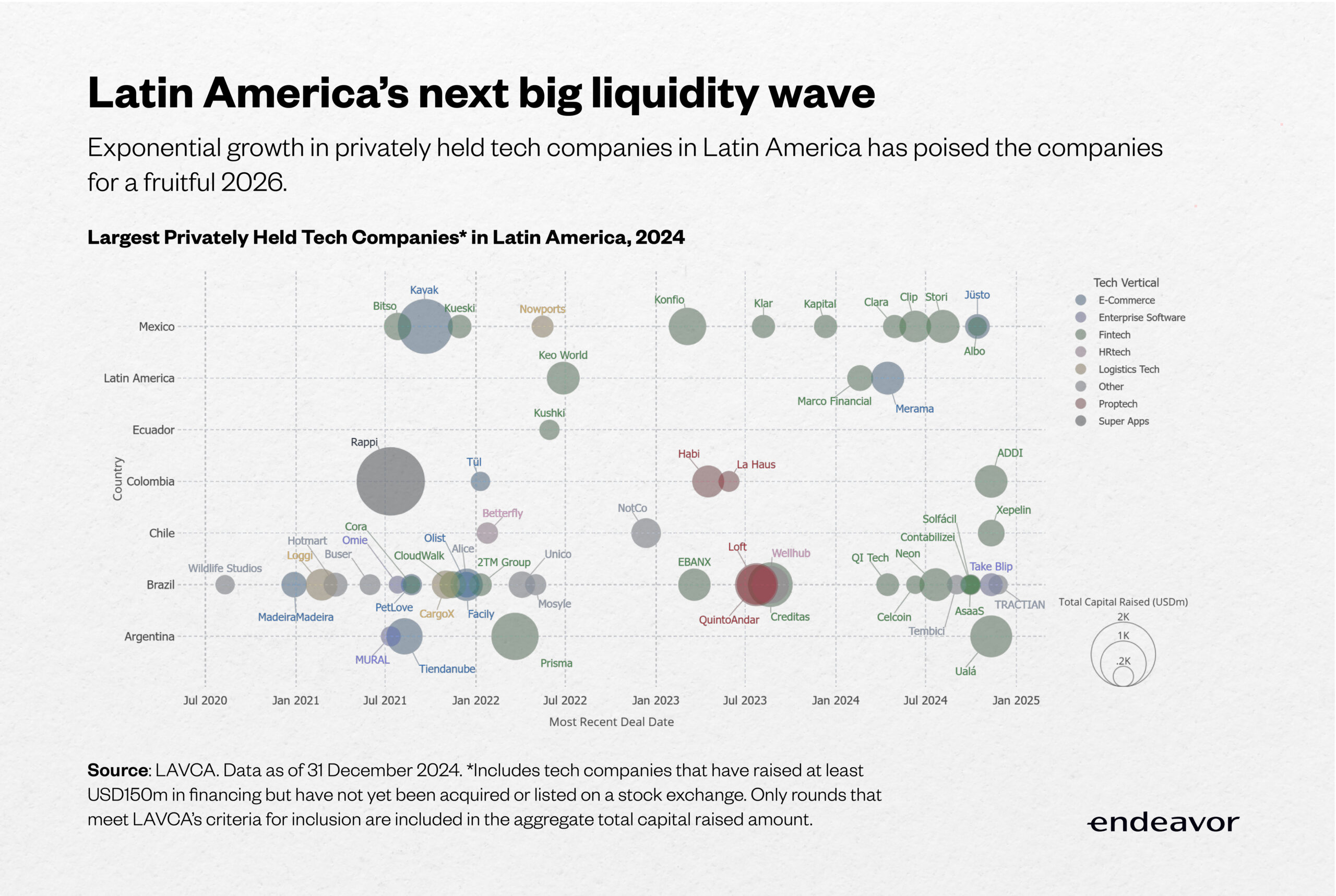
Latin America’s venture ecosystem is maturing, with the region’s most active investors seeking to harvest their winners, and more than a handful of the “breakout” success companies preparing for future IPOs.
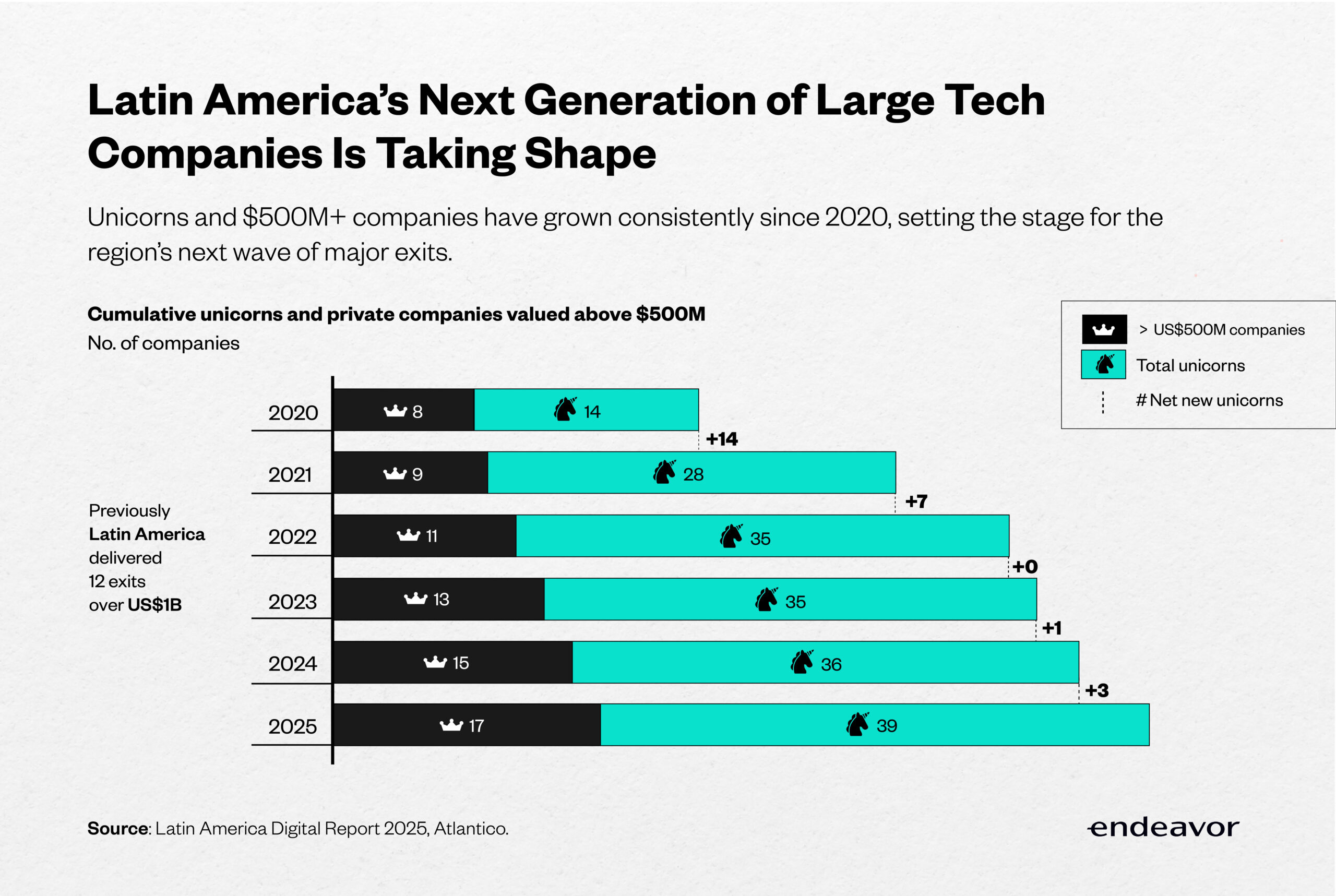
With 39 unicorns — nearly triple the number in 2020 — and more than 60 tech companies that have raised $150M+ but have yet to exit, 2026 is shaping up to be the year of liquidity preparation. As companies await more favorable market conditions, late-stage activity is expected to remain strong, with new financing rounds bridging founders toward future liquidity events.
Company Spotlight
We’ve seen this momentum reflected through several transactions within our portfolio:
- Klar (Mexico), a Mexican digital bank, raised a $190M Series C led by General Atlantic at an $800M valuation;
- Kavak (Mexico), a used car platform, raised $127M from General Atlantic and SoftBank at a $2B+ valuation;
- Creditas (Brazil), digital lending platform, is preparing a $100M+ round at a $3B+ valuation.
Early signs of liquidity are already materializing — though not yet through IPOs.
- This year, we exited Contabilizei (Brazil), a leading accounting firm, via secondary sale as part of its $125M round led by Warburg Pincus and R2 (Mexico), an embedded lending infrastructure company in Latam, as part of its round led by Ant International;
- Conta Azul (Brazil), a cloud ERP solution, was acquired for $300M by Visma.
When public markets once again present favorable conditions for Latin American listings, the US is expected to remain the preferred listing destination. In Brazil, however, there is a growing push to enable local investors to invest in high-growth local companies through Brazilian Depositary Receipts (BDRs) on the B3 Stock Exchange. We saw this with Nubank’s 2021 dual listing on both the New York Stock Exchange (NYSE) and B3, and continued this year with Prosus, which listed to provide local exposure to companies such as iFood, Decolar, and OLX.
As the region strengthens its late-stage pipeline and expands local investor participation, Latin America is positioning itself for the next defining wave of venture-backed liquidity events, anchored by stronger fundamentals, global investor confidence, and an increasingly sophisticated ecosystem.
" With US tech listings picking up again, we expect the window for LatAm and Brazil tech IPOs to reopen most likely in the second half of 2026, but we’ll wait for the right timing. We don’t force exits at any cost."
Maria Tereza, Softbank, Founder
Liquidity in Brazil Report, Endeavor Brazil (2025)
6. Saudi’s 2030 roadmap is reshaping the Middle East.
Saudi Arabia’s Vision 2030, a push to transition from oil dependency to innovation-led growth, is catalyzing changes across the region. Contemplated regulatory changes, including simplifying and streamlining the traditional listing process, are opening new channels for liquidity.
Government-backed funds like the Saudi Venture Capital Company (SVC) — also the biggest LP at Endeavor Catalyst — are injecting anchor capital into private markets, while fast-growing startups like Unifonic (Saudi Arabia) are launching their own venture arms and re-investing in the local entrepreneurial ecosystem. This coordinated top-down effort has created a surge of entrepreneurial momentum, and by 2030, its impact will be visible not just in Saudi Arabia but across the Middle East.
Company Spotlight
In just the third quarter of 2025, venture capital raised in the Middle East hit a record-breaking $1.2B, driven by mega deals such as Hala’s (Saudi Arabia) $157M Series B. Mergers are also increasing in the region:
- B2B marketplace Sary (Saudi Arabia) merged with Bangladesh’s ShopUp to form SILQ Group in 2025;
- MaxAB (Egypt) joined Wasoko to create Africa’s largest B2B e-commerce network.
Companies in our portfolio are also exploring near-term IPO opportunities, including Gathern (Saudi Arabia), Tabby (UAE), and MNT-Halan (Egypt).
The growing momentum in Middle Eastern capital markets points to a rapidly maturing venture ecosystem — a trend to watch as coordinated policy efforts continue to shape the region’s next wave of entrepreneurship.
" What’s happening in Riyadh and in Saudi Arabia has its ripple effects across the whole region."
Lateefa Alwaalan
Managing Director of Endeavor Saudi Arabia
7. Europe’s technical CEOs are turning deep science into global companies.
For decades, strategic and managerial expertise ruled the corner office. Today, Europe is rewriting the rules with a new breed of technical CEOs. Fueled by €200B of governmental investment in AI and infrastructure, a deepening pool of STEM talent, and growing needs of managers who can drive product innovation from the ground up, technical leaders are taking the helm.
Luca Rossettini, the CEO of D-Orbit (Italy), holds a master’s degree in aerospace engineering. The CEO of Bending Spoons (Italy), Luca Ferrari, holds a degree in telecommunications engineering. Andrei Danescu, the CEO of Dexory (Romania), holds a master’s degree in motorsport engineering.
Europe’s venture landscape is evolving in parallel, with both founders and funders converging around science-driven innovation. Limited partners now rank Deep Tech as the second most promising segment in VC, and it attracted almost one-third of VC funding in Europe in 2024.
Company Spotlight
This is reflected within Endeavor, with companies working in both outer space and below sea level:
- Submer (Spain) is a company specializing in immersion liquid cooling solutions for data centers;;
- ICEYE (Poland) owns the largest constellation of synthetic aperture radar (SAR) satellites to detect and respond to changes in any location on Earth;
- XOCEAN (Ireland) operates the world’s largest fleet of uncrewed surface vessels to map the ocean floor;
- WSense (Italy) leverages acoustic waves to enable wireless underwater communications.
In their success lies a larger story: Europe’s technical CEOs are translating world-class research into globally competitive technologies – redefining how scientific and engineering breakthroughs are built, led, and commercialized on the continent.
8. Nigeria has a local formula for global success.
There are now five unicorns in Nigeria — and two of them were founded by Endeavor Entrepreneurs. More are just beyond the horizon. Each began by solving local problems that mirror challenges across other emerging markets, before successfully scaling internationally. What these companies share are institutional-grade systems that regulators trust, strategic partnerships that enable expansion, access to ample growth capital, and a clear global vision.
Company Spotlight
In our own portfolio:
- Moniepoint, an all-in-one payments, banking, and operations platform for businesses and their customers, closed its Series C, reaching a total of $200M to support its international expansion;
- Flutterwave, a payment solutions company for businesses, now operates in over 30 countries and recently announced a multi-year partnership with Polygon to integrate stablecoin payments;
- Moove, a revenue-based vehicle financing company backed by Uber, recently expanded its partnership with Waymo and acquired urban mobility company Kovi (Brazil), to expand its footprint in Latin America;
- LemFi, a remittance platform, acquired Pillar to expand its services to migrant communities in the UK, Europe, and Canada, and has raised additional capital to scale further into Asia and Europe.
Increasingly, Nigerian startups are building for the world, exporting resilient business models and serving global customers. As investor confidence deepens and infrastructure matures, Nigeria is solidifying its position as Africa’s tech epicenter and a launchpad for globally scalable innovation.
This content reflects the views of the authors at the time of publication and is for informational and entertainment purposes only. It should not be relied upon as investment, legal, tax, or other advice. Nothing herein constitutes an offer to sell or a solicitation of an offer to buy any security or interest in any fund or investment vehicle. References to companies are illustrative only and do not represent all investments by Endeavor Catalyst. Past performance is not indicative of future results.
Featured Stories
Silicon Valley got crowded again. Here are 400 reasons why we’re staying Elsewhere.

2025 Endeavor Catalyst Annual Report: A Look into Global Venture Capital
The Race for the Next AI Success Story Is Not Where You Think

‘I don’t want to talk to any of you’: Addressing the VC Blindspot

AI isn’t confined by geography; capital is. Let’s shift the map.

Related Articles
Silicon Valley got crowded again. Here are 400 reasons why we’re staying Elsewhere.
2025 Endeavor Catalyst Annual Report: A Look into Global Venture Capital
The Race for the Next AI Success Story Is Not Where You Think